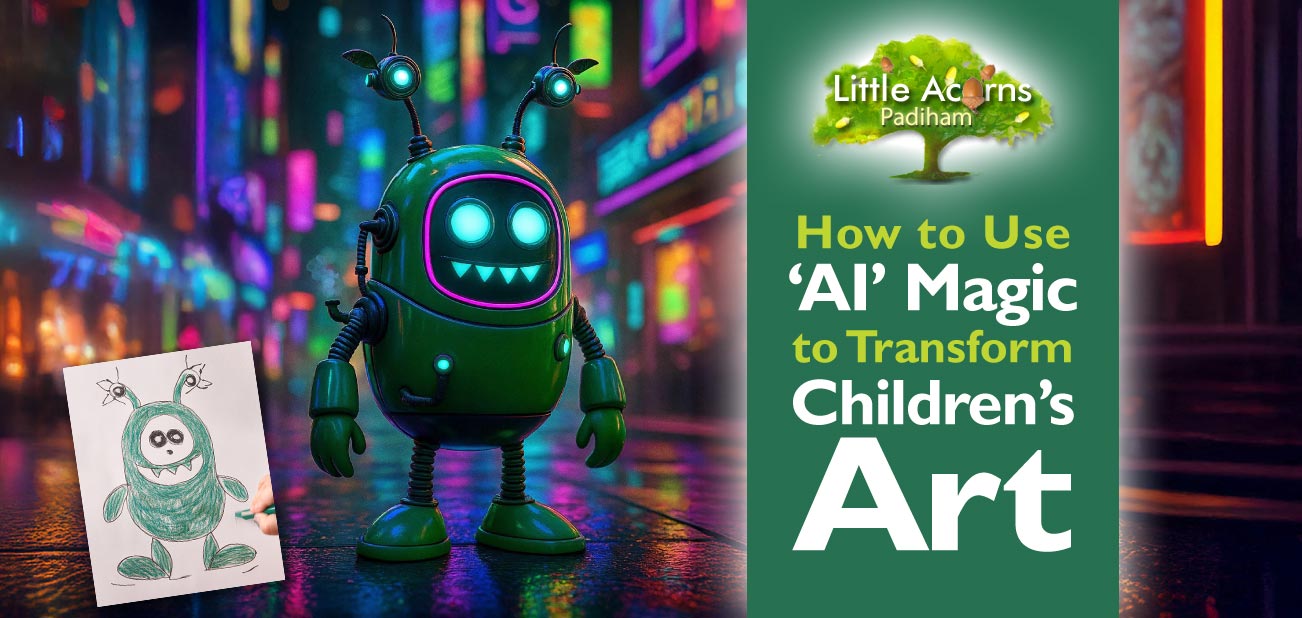
Today, we bring you a fabulous children’s activity. It is one that will encourage them to use their imaginations and get creative while also discovering how to easily transform their art to an astonishingly professional level. Using widely available Artificial Intelligence (AI) tools through help from a parent, their drawings and paintings can be magically enhanced to qualities so sophisticated that they’d look at home in a movie — the results are truly astounding! What’s more, the activity is fun, simple, quick, and achievable for free. It will also show children that their art and creative ideas matter and are valued. Read on to learn how to delight both children and parents by turning kids’ simple drawings into amazingly detailed digital art through the power of AI.
Examples of Children’s Art Transformed by AI
First, to give you a flavour of what’s possible in mere minutes, take a look at the amazing examples we’ve generated below. These show how children’s drawings have been taken to incredible new levels using free AI tools.
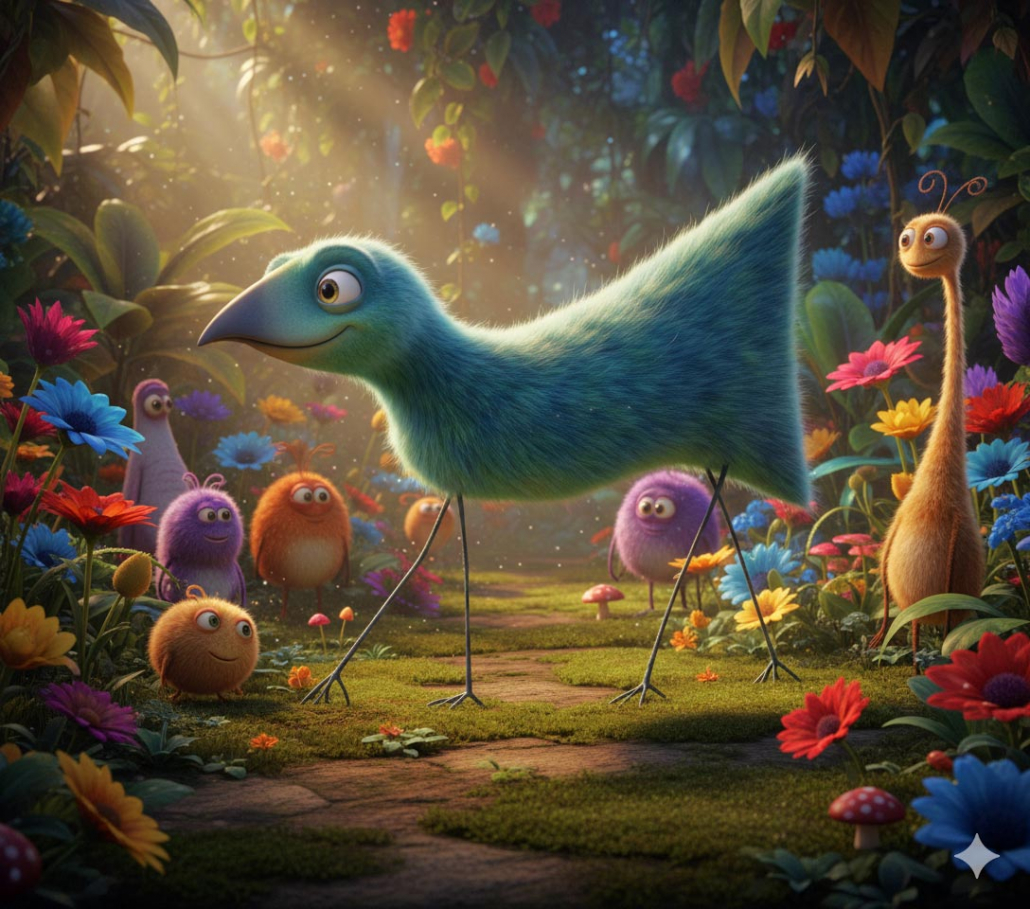
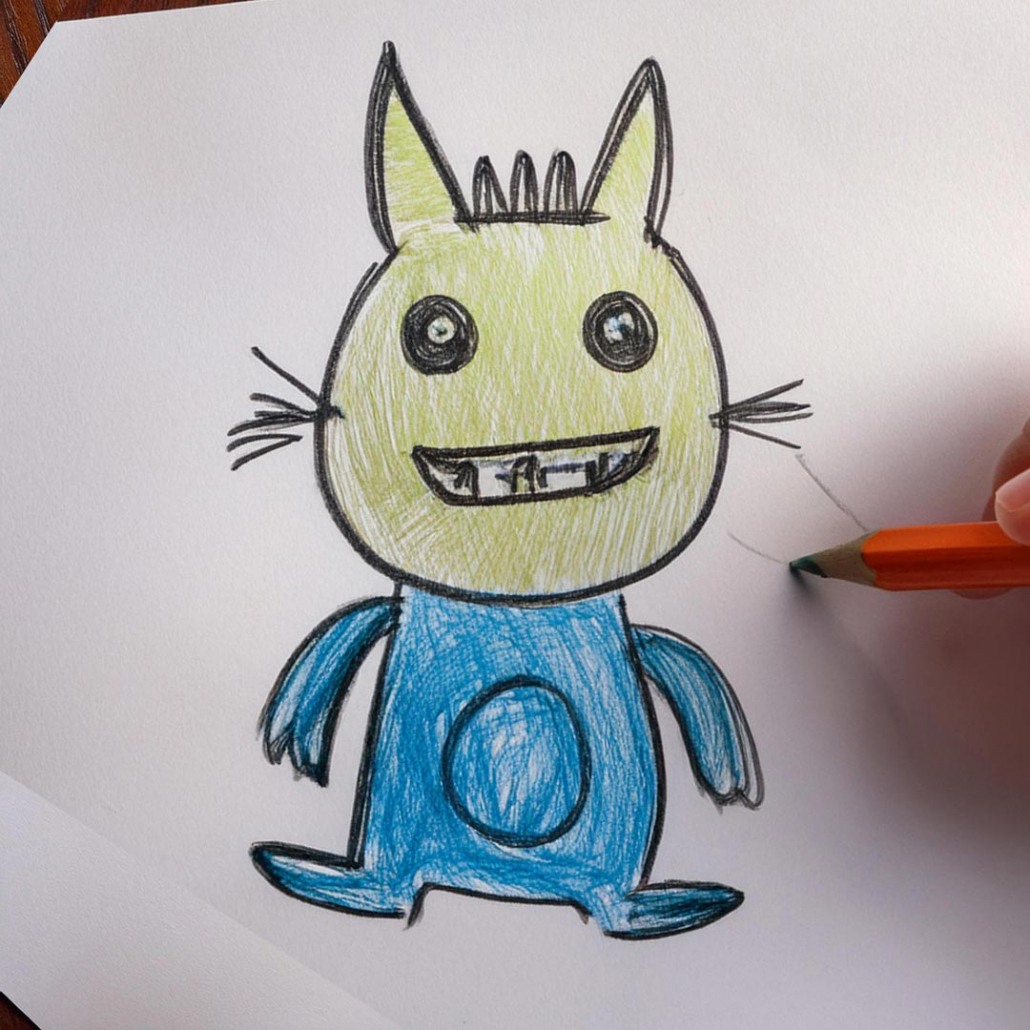
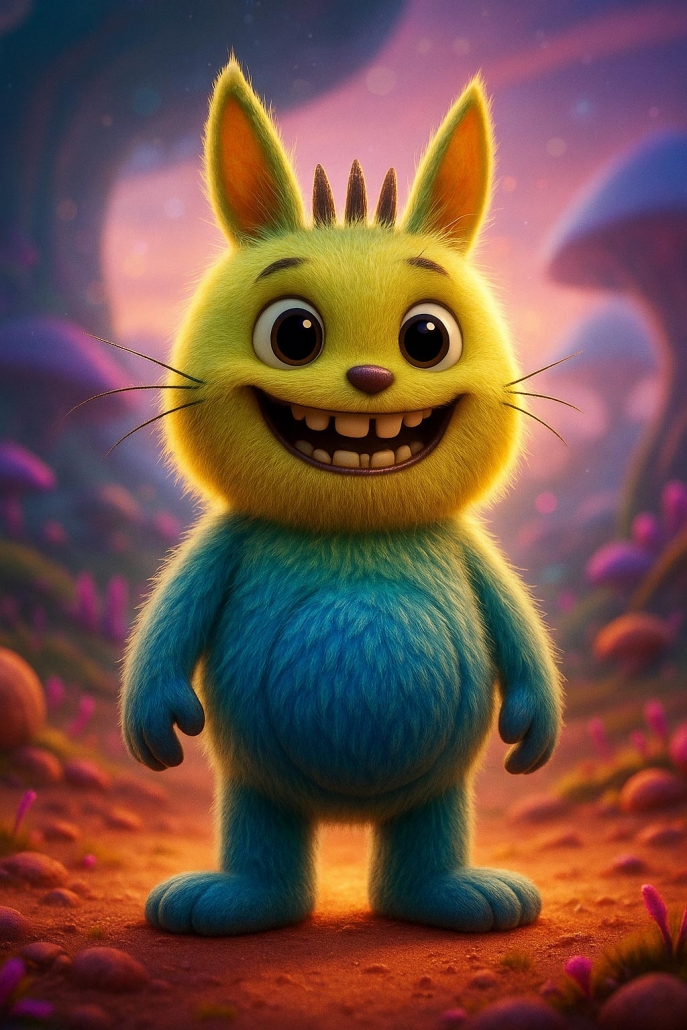
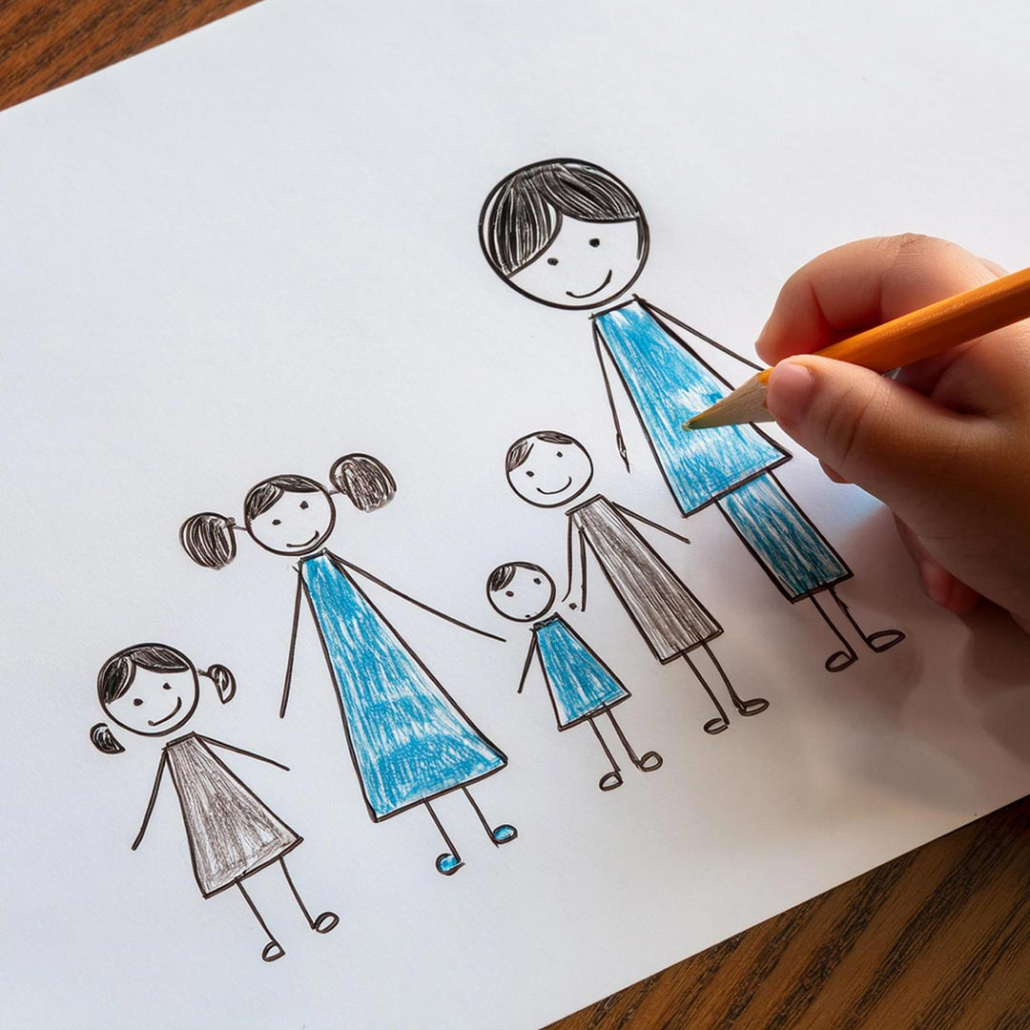
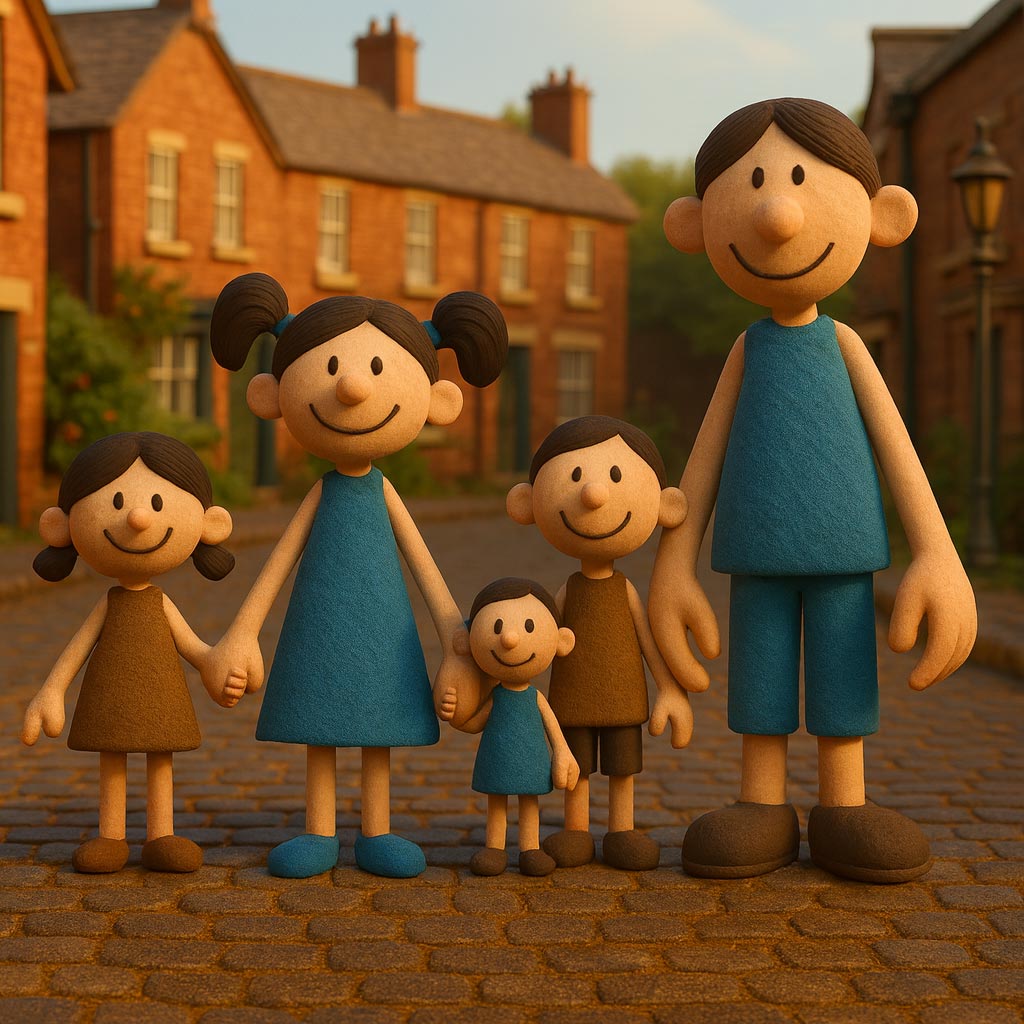
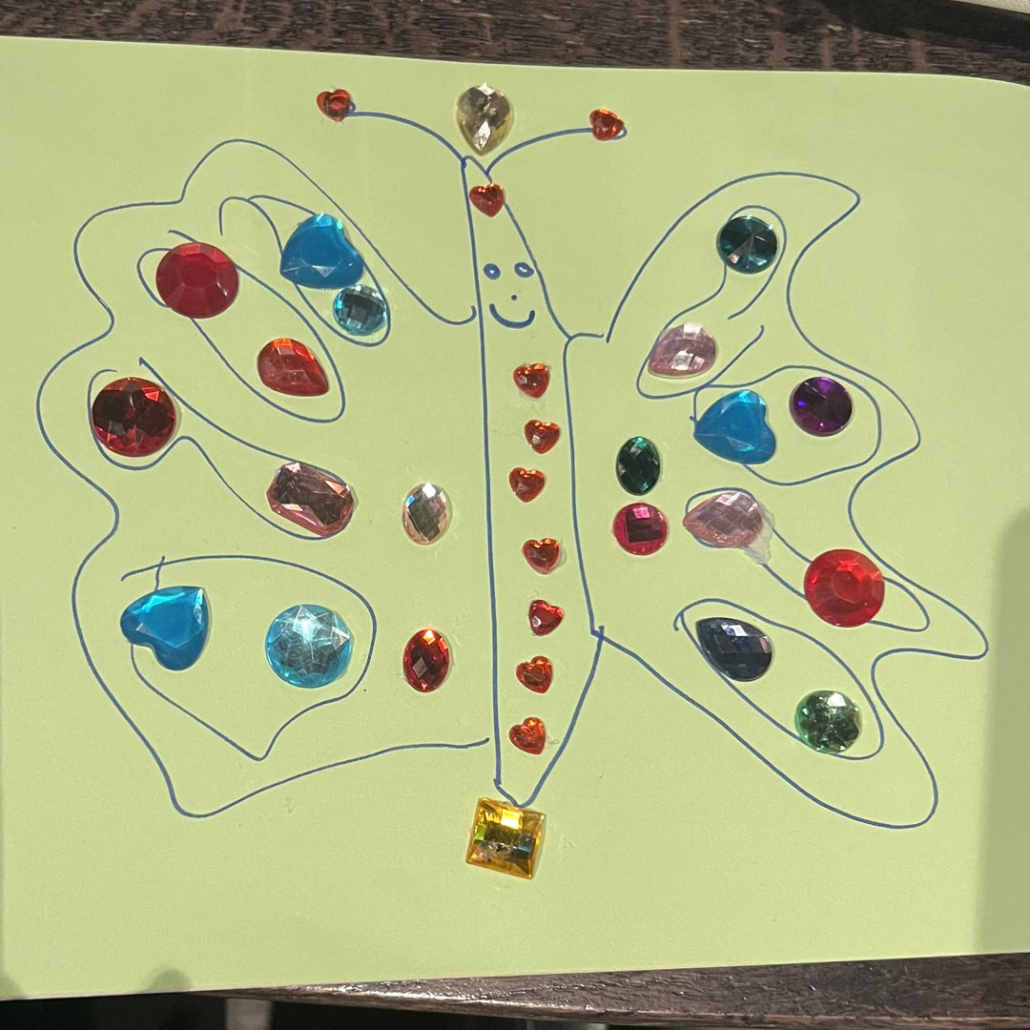
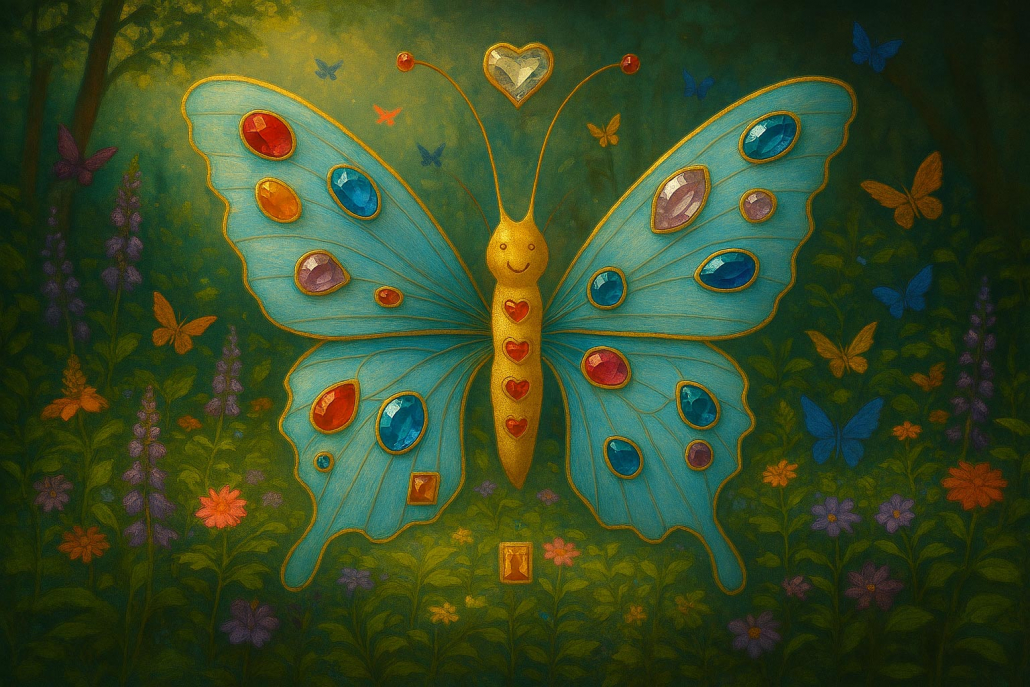
All of our examples were achieved free of any fees. Incredible, aren’t they? Now, imagine how delighted your own child would be if their drawings or paintings were transformed in a similar way. Let’s take a look at how that can be achieved.
How to Transform Children’s Art Using AI
The steps involved in a child’s art transformation boil down to 5 simple steps:
- The child creates a simple picture, as they would normally, through drawing, painting, a collage, or using whatever media they choose.
- The finished art is photographed digitally. This is easily accomplished using a digital camera, a smartphone camera, or a desktop scanner. The art is best photographed ‘flat’ (i.e. from above). It’s best to avoid casting shadows on the work while photographing.
- The image file is uploaded to an AI tool (more about those later). A parent will need to help young children for this and the next step.
- Tell the AI tool, in detail, how you/your child wants the drawing or painting to be transformed.
- Then wait a few moments for the results (get ready to be amazed!).
Steps 1 and 2 speak for themselves, but we’ll explain a bit more about steps 3 and 4 below.
Which Artificial Intelligence Tool Should Families Use?
For Step 3: There are several powerful AI tools that can be used for this activity, free of any fees (within certain limits*). At the time of writing, free options suitable for this activity include OpenAI’s ChatGPT, Google’s Gemini, Microsoft’s Copilot and, no doubt, several others. For Windows 11 users, we suggest starting with Copilot because it is bundled natively as part of that operating system. ChatGPT and Gemini are also excellent options and are available via browsers as well as smartphone apps. We currently suggest avoiding X’s Grok for reasons† that will be apparent to anyone following recent news.
Uploading a digital photograph of your child’s art is achieved simply by uploading it via the AI tool’s chat prompt field. For many tools, including our suggested examples above, you simply click the “+” symbol or “Attach” option in the chat window, then select the option to upload an image — for example ‘add photos/files’, ‘upload’, or similar. In the same chat window, immediately after uploading the art image, you’ll need to write a ‘prompt’ to tell the AI tool how you’d like it to transform the child’s art. We’ll cover that next.
* Limits for free versions may include the number of attempts per hour/day, whether you’re logged in to an account, and how busy the AI servers are at any particular time.
Writing Your AI Prompt
Step 4 is the part where the AI tool is told what to do with the child’s uploaded image. A parent or responsible adult should help proactively with this part. After discussing what the options are and agreeing a desired outcome with the child, the parent should type instructions into the AI tool’s chat prompt. You can ask for the child’s art to be transformed into any number of styles, including cartoon style, Pixar animation style, Wallace & Gromit clay animation style, Toy Story toy style, Steampunk style, etc. You can ask for a particular style of lighting, textures like fur or feathers, and materials like metal or plastic, specify what you’d like to see in the background, and so on. A couple of examples may help…
Example 1
The accompanying metal ‘robot’ image was output by the AI tool (ChatGPT in this case) after loading the child’s drawing shown, and entering the following prompt:
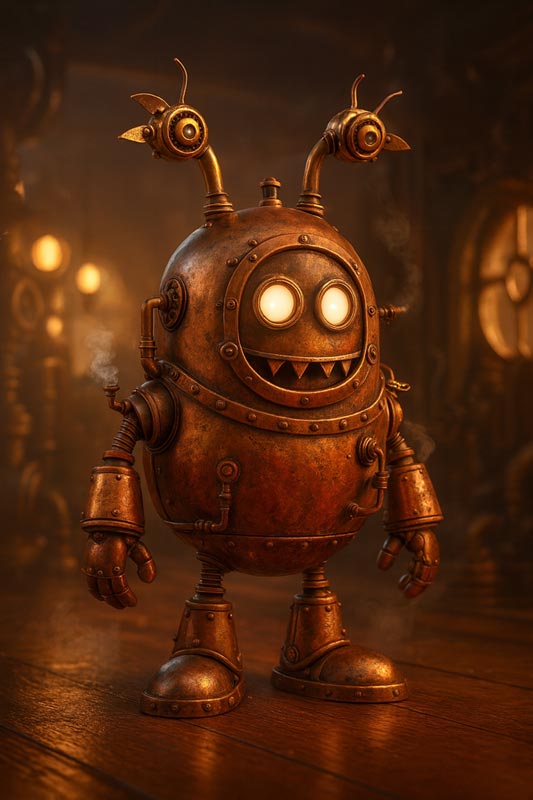 Please turn this drawing into a Pixar-quality 3D render in a Steampunk style. Keep the robot’s shape and personality true to the child’s original drawing, but bring it to life with detailed Steampunk textures — like aged brass, polished copper, gears, cogs, and small steam pipes. Give it warm lighting with soft reflections to create a cinematic, high-quality look. The robot should have expressive eyes or lights, a slightly worn but friendly appearance, and visible mechanical details that make it look handcrafted. Place it in a retro-futuristic setting filled with soft light and a bit of steam, so it feels like a moment from a Pixar film.
The incredible finished result is shown (click to enlarge it so you can see the amazing detail).
Example 2
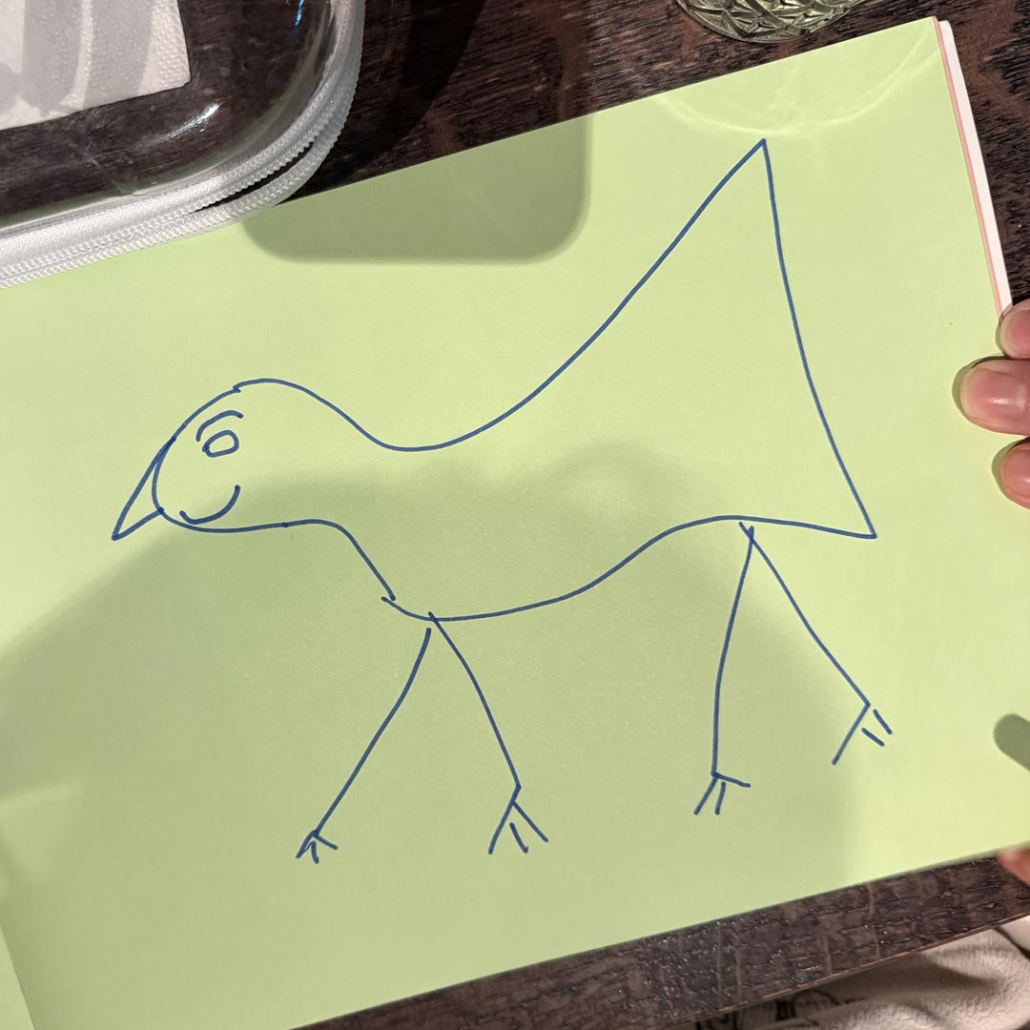
Our second example shows how a child’s drawing of a girl was transformed by AI (Copilot for this example) into a handcrafted marionette doll, with textures and lighting, etc. specified using the following prompt:
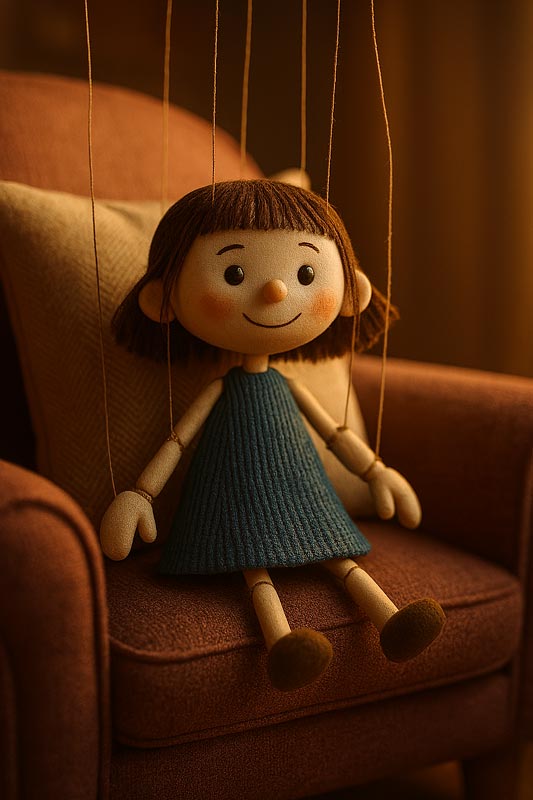
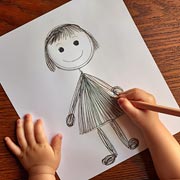 I’ve uploaded an image of a child’s drawing of a girl. Using only that person (i.e. ignoring the child’s hands, finger(s), pencil/crayon, tabletop, border, etc.), please render it in the style of a child’s doll-like puppet, with fabric clothing, a china/porcelain-like head with fake hair, strings coming from above (for the puppet element) attached to limbs, head, legs etc. It should be situated on a child’s comfy bedroom chair, leaning against a cushion. Soft, warm, lighting as if the sunset sun is lighting it through a window that’s not in view.
The child’s original drawing can be compared to the impressive AI render (click it to enlarge it, to view in greater detail).
Isn’t it clever?
Why This Matters & How It Helps Children
Children will be amazed and delighted by the way their drawings and art pieces are brought to life — all in just a few minutes. It’s a great way to show them, in a safe and responsible way, how it’s possible to take simple concepts to whole new levels of sophistication using freely-available AI tools. Using AI in this way also allows them to create details and ideas that they’re not yet able to accomplish using only their manual skills. AI transformations will also demonstrate that their pieces of art matter and have value.
This activity will boost creativity, not replace it.
This activity will boost creativity, not replace it. It will allow children to accomplish art that they could previously only imagine. It’ll show them, in just moments, how it’s possible to take their ideas to new, sophisticated levels. Helping to decide on descriptive prompts will also help them nurture communication skills. So, this is far from being anything like a shortcut or ‘cheating’.
AI transformations will also demonstrate that children’s pieces of art matter and have value.
A responsibly approached introduction to AI will also give them a safe insight into the world of tech and how it can help mankind. Love it or loathe it, AI is something youngsters will grow up around. Therefore, children need to know about it, understand how it can be used, and perhaps consider how they may one day work alongside it once they become adults. Most importantly, though, today’s activity will show children something that’s rather like gold dust — the power of their own potential!
Little Acorns Nursery
Your High-Quality Childcare Nursery in Padiham, Near Burnley
 Are you searching for a high-quality childcare nursery in Padiham or near Burnley? Little Acorns Nursery would love to meet you and your little one if so. Contact us today to explore the possibility of your child attending this fabulous childcare setting, which is rated as ‘Good’ by Ofsted, and supports free childcare hours for eligible families.
Please click an option below to get started:
Little Acorns Nursery may suit families looking for a good childcare nursery in Padiham or near to Burnley, Hapton, Rose Grove, Altham, Huncoat, Read, Simonstone, Sabden, Higham, or Wood End.
† Safety notice: Parents should do their own research, be responsible with their use of prompts, and supervise children closely when using AI tools for this and any other such activity.
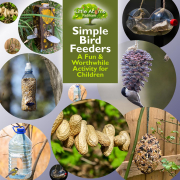
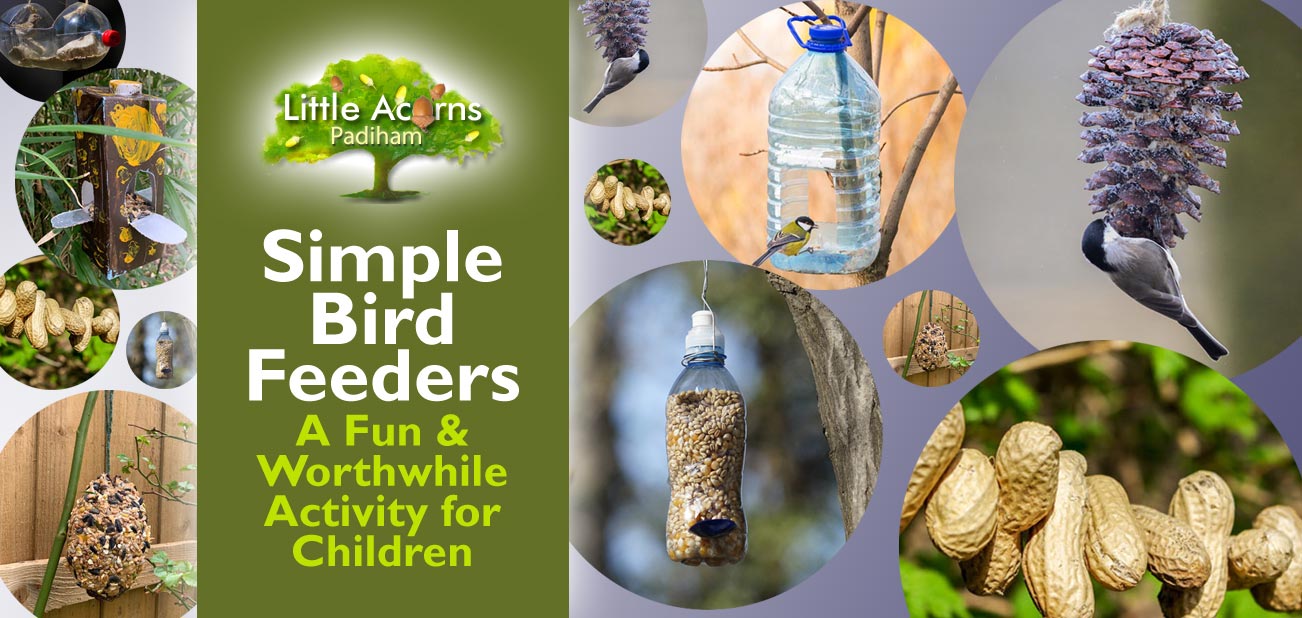
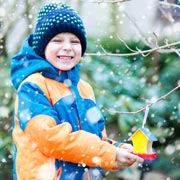 One fantastic way to encourage children to connect with nature from an early age is by making homemade bird feeders. It’s a hugely popular activity amongst children of all ages, so today’s post is all about how to get started with your child. Although bird feeders can be made at any time of the year, the activity is perfectly suited to the winter and early spring. At this time, wild birds like robins, blackbirds, doves, and sparrows are really struggling to find food. And, with World Wildlife Day arriving in the first week of March, it’s very timely. Take a look!
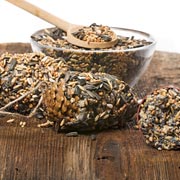 A large, dry pine cone
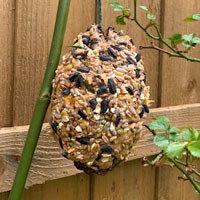 Tie a piece of string securely around the top of the pine cone to create a hanger. Then, let your child spread peanut butter all over the pine cone using a spoon or butter knife. Next, roll the sticky pine cone in a tray of birdseed until it is fully coated. Once completely covered in birdseed, hang it outside on a tree branch or hook and watch as birds come to enjoy their treats!
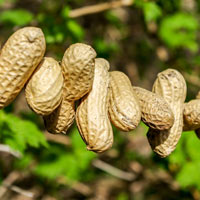 Carefully thread the string through the outer shell of the monkey nuts, tying knots if needed to keep them spaced apart. Once you have a long garland, either tie the ends together to form a loop that can be suspended vertically or attach each end to stretch them horizontally between branches of twigs on a tree or bush. Once birds are used to the new addition to the garden, watch as blue tits, great tits and others enjoy cracking open the shells!
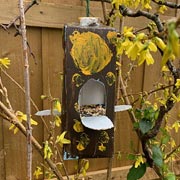 Cut out one or more large holes on the sides of the carton to create openings (adults should do this part for younger children). Thread can be attached at the top – try trapping it under the lid or get an adult to thread it through a hole. Let your child decorate the feeder with paint, stickers, or non-toxic markers. Fill the carton up to the opening(s) with birdseed and hang it up in your garden or balcony.
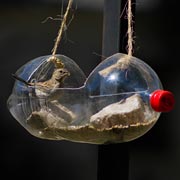 A clean, empty clear plastic water bottle
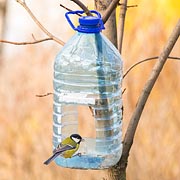 There are a few options for this type of bird feeder, as indicated in the photo examples. Either way, small feeding holes or ‘hatches’ will need to be cut (by a supervising adult) as openings. Optionally, cut small holes on opposite sides of the bottle and insert wooden spoons or sticks through them to create perches. Fill the bottle with birdseed and tie a string to hang it outside. Watch as birds land on the perches and enjoy their treats!
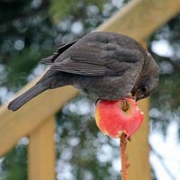 Expose some of an apple’s sides by removing some of the skin. Then, either attach string through (or around) the apple and hang it from a branch outside, or push a stick into it (carefully aimed away from you in case it goes right through) and push the other end into the ground. Watch as birds peck away at the tasty treat! Blackbirds, in particular, love apples!
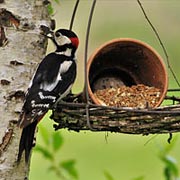 Our personal favourite and key recommendation is sunflower hearts. These are the little kernels inside sunflower seeds and the good news is that by buying them as sunflower ‘hearts’, birds don’t need to remove the shells. Robins, blackbirds, doves, dunnocks, bluetits, great tits and pigeons love them! They’re generally inexpensive, in our experience, and are available widely, including in supermarkets.
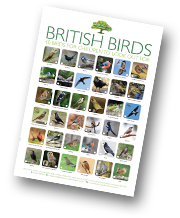 Once your bird feeder is in place, keep an eye out for common garden birds. Typically, birds that are attracted to bird feeders in gardens include robins, bluetits, sparrows, and dunnocks although it does depend on what food you put out for them. Children are also likely to see larger birds like blackbirds, doves, pigeons, magpies and even crows, as they are likely to scavenge underneath for seeds that have dropped from the feeders. To help children identify which birds visit, ensure you have printed out our
 One of the many reasons we love nature and nature-based children’s activities here at Little Acorns Nursery is that nature is incredibly beneficial to children. What’s more, the benefits start right from their earliest years and are profoundly powerful to little ones. There have been many studies about this over the years and they all seem to conclude that nature is incredibly good for us all, especially so during the early years. Today’s post looks at 20 of the key benefits that spending time in and around nature holds for children and, with Spring now upon us, it’s the perfect time to begin getting little ones outside more, weather permitting.
 Spending time in and around nature means children are more likely to be active, for example, walking, running, skipping, climbing, playing, making, or simply building a den. Such activities will not only help them hone fine and gross motor skills, but will also improve coordination, balance, and fitness. Those skills will help them day-to-day while expending energy in this way will help them maintain a healthy weight and body-mass index.
 One of the more obvious benefits of nature is that it gives children a huge sense of freedom that they might not otherwise experience. Being in The Great Outdoors allows children, under appropriate supervision, to run, explore, and play in ways that are far more free than in any other situation. This will also give them a huge sense of natural joy.
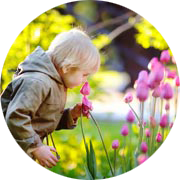 The stimulation of the senses is never more important than during children’s early years and spending time in nature is the perfect vehicle through which to do so. With so many colours, sounds, smells, textures and even (under adult supervision) tastes available in the natural world, it is indeed a feast for children’s senses. Through the senses, children will learn more about the world and generate millions of new connections in their developing brains. It’s almost magical!
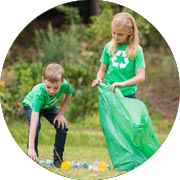 Being around nature regularly can also help children lean naturally towards environmental issues, learn about the problems and become part of the solution. An appreciation of nature is indeed the first step towards becoming environmentally conscious and proactive. That’s a great thing for the planet, particularly as today’s children will become tomorrow’s custodians of the Earth.
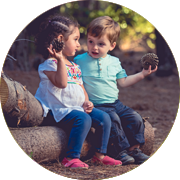 Children generally team up with friends when they’re playing and exploring outdoors. Spending time playing together in natural environments fosters many different kinds of interaction. This can boost confidence, language, communication and social skills. Stronger bonds and a deeper understanding of peers are likely to form from this.