
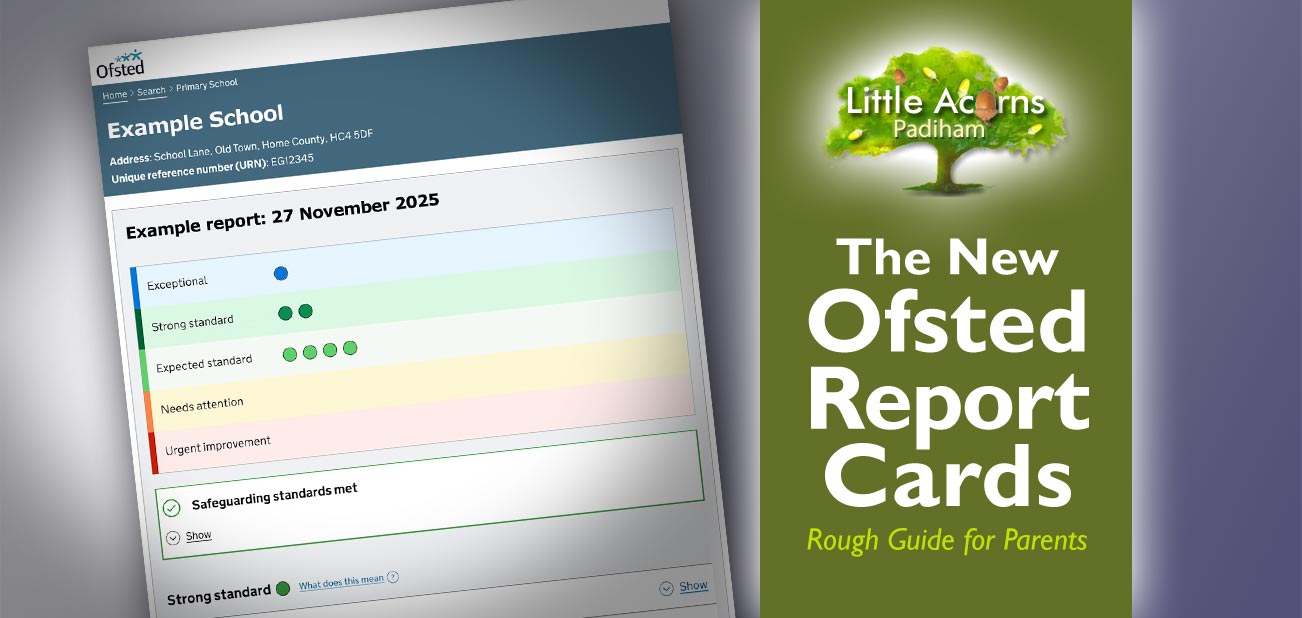
Since November 2025, Ofsted has been rolling out new-style assessments for early years providers, schools, higher education settings, and skills providers. Parents will therefore start to notice the new way of presenting Ofsted ratings. They are multifaceted, with comprehensive detail, and also provide contextual information and metrics that give greater meaning to assessment conclusions.
Key to the new Ofsted assessments is the new, multi-part Report Card. This combines a quick, colour-coded snapshot of the setting’s performance, with sub-sections that delve deeper into how the setting measured up against key areas. All of this replaces the historical approach that, until now, simply used short, some would say controversial, one or two-word “judgements” — Outstanding, Good, Requires Improvement, or Inadequate. Today, we take a look at the new Report Card, explaining how it is presented and what information this new assessment reporting will contain.
The New Ofsted ‘Report Card’
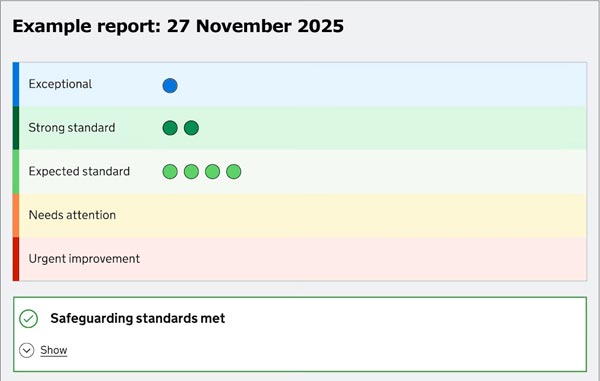
As you can see in our example, the most prominent part of Ofsted’s new Report Card is a colour-coded area that indicates how the setting performed, at a glance. Coloured dots represent key areas and what ‘grade’ they achieved, although they’re not named at this stage. The distribution of coloured dots is a way to see, very quickly, how a setting is performing overall.
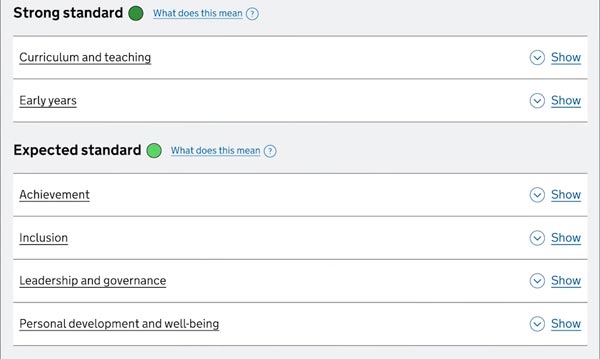
- Areas judged to be ‘Exceptional’ are denoted by blue dots;
- Those with a ‘Strong standard’ are awarded dark green dots;
- Those reaching the ‘Expected standard’ are indicated by bright green dots;
- If an area ‘Needs attention’, it’s indicated by an orange dot;
- And finally, areas that need ‘Urgent improvement’ will be shown as a red dot.
If all is well at a setting, parents will see just greens and, if exceptional in any areas, blues. A good facet of this new approach is that, if a setting is doing well in many of its key areas, it will no longer “live or die” if there is a shortcoming in another key area. Yes, they may see an orange or red dot, but they’ll also be able to instantly spot that the setting is doing well in other areas (green and blue dots). So, it’s a more comprehensive and balanced way to represent a setting.
What Key Areas do the Coloured Dots Represent?
The coloured dots represent defined “key areas” assessed by Ofsted inspectors. The key areas vary a little depending on the type of setting being assessed, as listed in the tabulated sections below.
Safeguarding on the Report Card
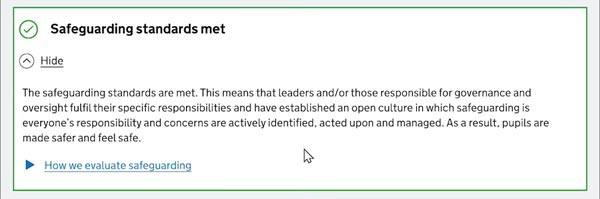
Safeguarding features prominently on the Report Card for all types of settings. It does so in a separate section of its own, below the top colour-coded section. There are just two possibilities for the assessment of the setting’s safeguarding: either Met or Not Met. And, as with many of the subsequent inclusions on the Report Card, the Safeguarding box is expandable. Users can click the ‘Show’ link to view detailed notes explaining what the finding means (see example below) and a further link that explains how safeguarding was evaluated by Ofsted. Both links can then be closed to return to the more compact view.
The Key Areas Section of the Report Card
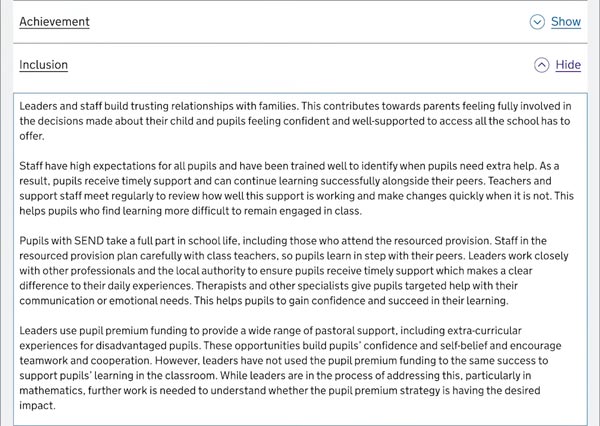
After the Safeguarding section comes the individual ‘key areas’ that we listed above and which were graded higher up in the colour-coded section. Grouped by attainment/colour (best/blue at the top), each now has an expandable box of its own. As with the Safeguarding box, users can click a ‘Show’ link that enables detailed Ofsted notes to be displayed. Such notes go into great detail about Ofsted’s findings about the metric in question. So, if the attainment is high, parents will be able to see how and why Ofsted thinks that to be the case. Likewise, if the attainment is lacking in some way, parents can see why Ofsted thought so and what they suggest the setting needs to do to improve matters.
Each of the sections expands as shown for the ‘Inclusion’ example below.
What It’s Like at the Setting & More
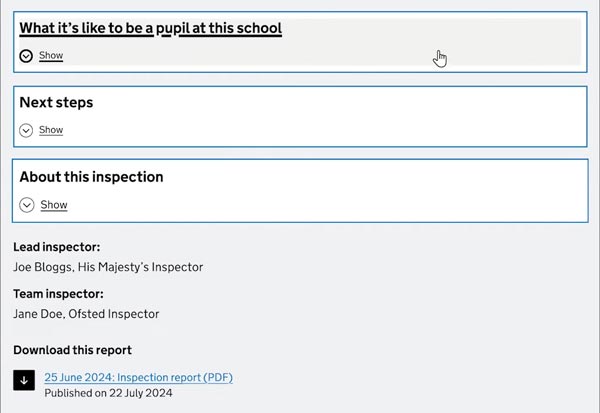
Below the Key Areas sections come 3 useful inclusions:
- The ‘What it’s like to be a pupil at this [setting]’ section does ‘exactly what it says on the tin’ and, if expanded to show the detail, explains what life is like at the nursery, school, further education setting or skills provider in question. It’s a new and useful inclusion for parents to consider as part of their search for an appropriate provider for their child.
- The ‘Next Steps’ section provides recommendations from Ofsted about what the provider can do to improve things (as appropriate).
- The ‘About this inspection’ section comes next and, if expanded, explains more about the inspection process on the day the Ofsted Inspector visited.
- The report card then goes on to name the Inspector(s), as well as providing a link to download the Inspection Report as an Acrobat PDF file.
The Facts & Figures Section
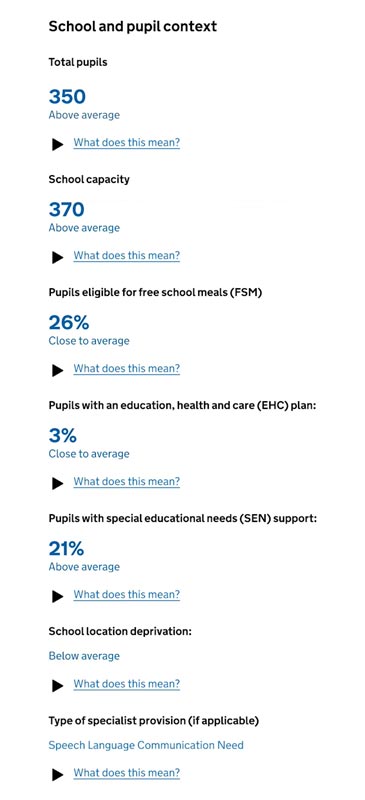
The final section in the Report Card contains contextual information that provides a kind of backdrop to the setting’s situation. Examples include the number of pupils attending, the capacity of the setting, the percentage of pupils with SEND and/or an EHC plan, whether the setting is in a deprived area, and so on. Click here to view an example. Such facts and figures provide some important context, including the highlighting of some challenges they may face, and may at least partly explain performance. As such, they are a useful set of new metrics for parents to factor in when finding a provider for their child.
Little Acorns Nursery, Padiham
Rated as a ‘Good Provider’ by Ofsted

 Little Acorns Nursery, Padiham, has not yet had a new-style Ofsted assessment. However, the setting has a ‘Good Provider’ status following the most recent Ofsted inspection back in May (2025). Indeed, Ofsted rated the nursery as ‘Good’ in every category. What’s more, at the time of writing, the nursery has a review rating of 5 out of 5 on Google and 10 out of 10 on DayNurseries.co.uk — it simply doesn’t get better than that! Parents can therefore rest assured that, if they send their child to Little Acorns Nursery in Padiham, they’ll be in safe and caring hands at a childcare setting that does everything it can to nurture their learning and development. That’s all in a safe, homely, and stimulating environment.
To register your interest for a nursery place, organise a tour of the setting, or ask any questions, please get in touch using one of the options below. We can’t wait to meet you and your child!
Families outside Padiham, but living in nearby locations, may also find Little Acorns Nursery convenient for their childcare needs, for example, those in Burnley, Hapton, Rose Grove, Altham, Huncoat, Read, Simonstone, Sabden, Higham, and Wood End.