
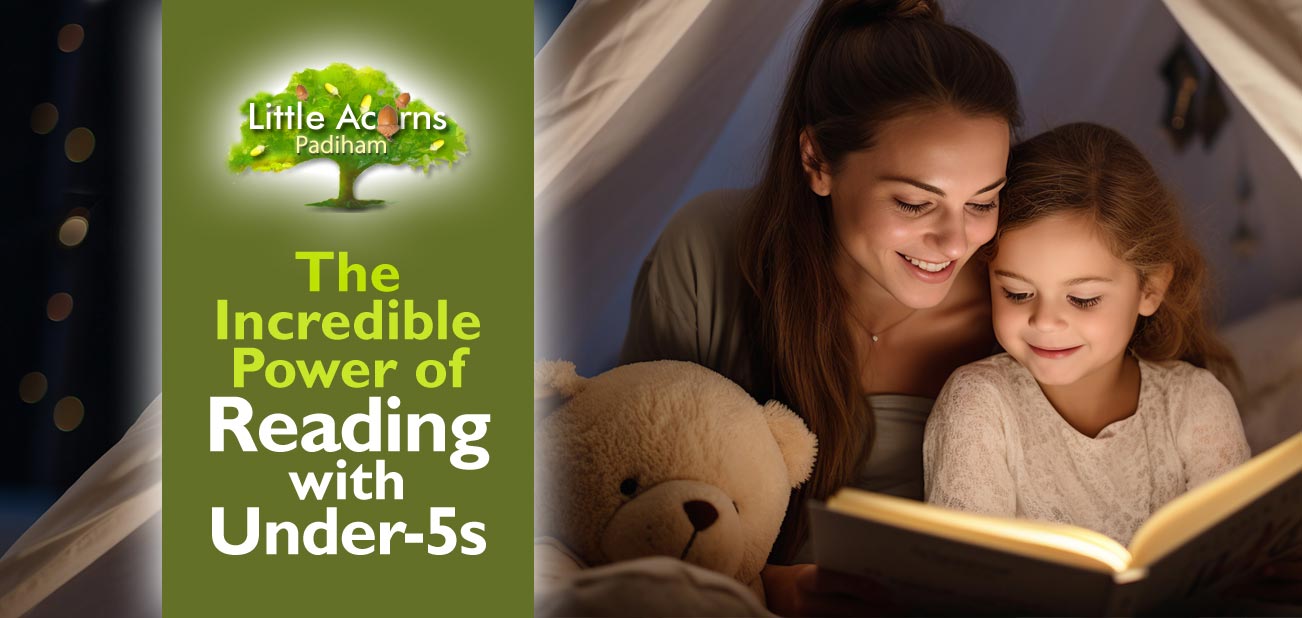
 Parents and caregivers have a simple yet incredibly powerful tool at their disposal to significantly boost the education of children under five: reading with them. In study after study, this simple activity has been shown to transform a child’s early years of education, giving children short-, medium-, and long-term benefits that even extend into adulthood. With that in mind, we take a look today at the many benefits and incredible power of reading with children, especially those under five.
Read with children, not just to them for the most positive impact.
That’s important as the most profound benefits to children come about when you read with them rather than just to them. It’s a case of involving and immersing them in the reading, which can be done in a variety of different ways to make it more interactive. We’ll explain more about how parents can do that later in this article*. First, though, let’s take a look at the benefits of reading with under-fives.
What Are Some of the Benefits of Reading With Your Child?
It turns out that reading with little ones punches well above its weight when it comes to enhancing young lives. In a nutshell, some of the key benefits of reading with children include significantly improved cognitive, emotional, and social development. Indeed, some of the benefits of reading with children are simply transformational. Even social mobility is improved because of reading with children in some circumstances. Let’s take a closer look.
Cognitive Benefits
 When you read to them, the cognitive benefits to children are profound and this is backed-up by findings from multiple studies. The benefits include improved memory, problem-solving, logical thinking, and memory skills. Even children’s attention spans are seen to improve when parents regularly read with them.
A Long-Term Academic Performance Boost
What’s more, many of these benefits are long-term ones and this means they positively impact children’s academic performance throughout all the school years and even beyond. This results in better grades, a wider choice of further education choices later on, and even career and income advantages once they become adults. That’s all accomplished simply through the act of reading with children in their early years — it’s incredible!
Reading with children in their early years encourages good reading habits and a natural love for learning.
A Social Mobility Boost
You can see why the above benefits can go on to improve the quality of lives once children reach adulthood. Indeed, studies have produced some remarkable findings in that regard. Several have found a strong link between children regularly reading with adults in the early years and improved socio-economic mobility later in life. This boost is even more prominent in children from economically disadvantaged backgrounds. So, reading with children is a great way to level the playing field and improve outcomes right into adulthood.
Emotional Benefits
Books are great vehicles through which children can glimpse and immerse themselves into different situations. For example, through reading books, they’ll learn about different characters, their successes and perhaps their struggles. As such, they’ll learn to see things from the point of view of others. This is a great way to nurture emotional intelligence in children, boost feelings of empathy, and better understand the feelings of others. This will be particularly important for their interactions with peers, friends and surrounding adults.
Supercharged Creativity
Books are a wonderful conduit to greater creativity in children. When adults read with young children and older children read solo, it opens up whole new worlds, situations, and characters to them. Through stimulation of their imaginations, they can see new possibilities, be inspired to create in different ways within their own writing and arts, and significantly boost creative skills.
Enhanced Language Skills
 One of the biggest winners when reading with children is the boost to their language skills. Indeed, a 4-decade study (∞) saw a massive 20% boost in such skills when adults regularly read with them. For the children studied, the average age was just 3 years and 3 months, meaning their language skills were boosted by the equivalent of about 8 months. That’s an enormous boost at such a young age. Receptive language (understanding), expressive language (verbal use of grammar and vocabulary), children’s understanding of word structure, and pre-reading skills especially benefited from early years reading with a parent or adult caregiver. Such skills lay wonderful foundations that will help children excel across multiple areas of education.
And Much More
The benefits outlined above are really just the tip of the iceberg. As well as these, additional benefits include allowing a closer bond to develop between the parent/caregiver and the child, greater comprehension of the world, a wider knowledge of multiple subjects, better self-expression, and social skills that are enhanced because of children’s improved vocabulary, understanding, and knowledge.
* How to Involve Under-5s When Reading
 If children are to get the most from reading, it’s important to read with them. That’s all about making it interactive, engaging and fun to ensure children are involved. There are a number of ways to accomplish this and doing so will be the key to them gaining the most benefit from the activity.
- Bring the storyline to life by being animated when you read to under-fives. Gesticulate, speed up or slow down your reading to reflect what’s going on in the text and to give life to the story. Give characters different voices, and try accents and different tones to really bring characters and storylines to life. Use different volumes as appropriate to the story unfolding, whisper to give tension, shout when a character shouts, and make the story seem as real as possible. This will make the reading on your part, and the story from the child’s point of view, more fun. It’ll draw and retain children’s interest and engagement, so they immerse themselves and really listen.
- Encourage your child’s interaction. Let them exclaim or answer characters, and ask them what they think may happen next, or what they might have done in that situation.
- Whether the book is fiction or non-fiction, encourage questions; it’s a great way for children to learn.
By making reading more engaging, it will help improve comprehension, boost critical thinking skills, and stimulate children’s creativity.
As you can see, the benefits of reading with children in their early years are truly profound. Through reading, children are learning constantly, improving themselves in multiple areas, and setting amazing foundations for present and future success.
High-Quality Childcare & Early Years Education in Padiham
 At Little Acorns Nursery in Padiham, Lancashire, we fully understand the importance of reading with children. It’s therefore one of the many tools used in the early years education of children under our care. At Little Acorns, we tailor the learning and development of every child to bring out the best in them across all areas of the curriculum. If you are a parent looking for a Padiham nursery for your child or a childcare nursery near Hapton, Rose Grove, Burnley, Altham, Huncoat, Read, Simonstone, Sabden, Higham or Wood End, consider Little Acorns Nursery for your little one. To explore the possibilities, get in touch and we’ll be happy to answer questions, show you and your child around, or explain the next steps towards registering for a place.
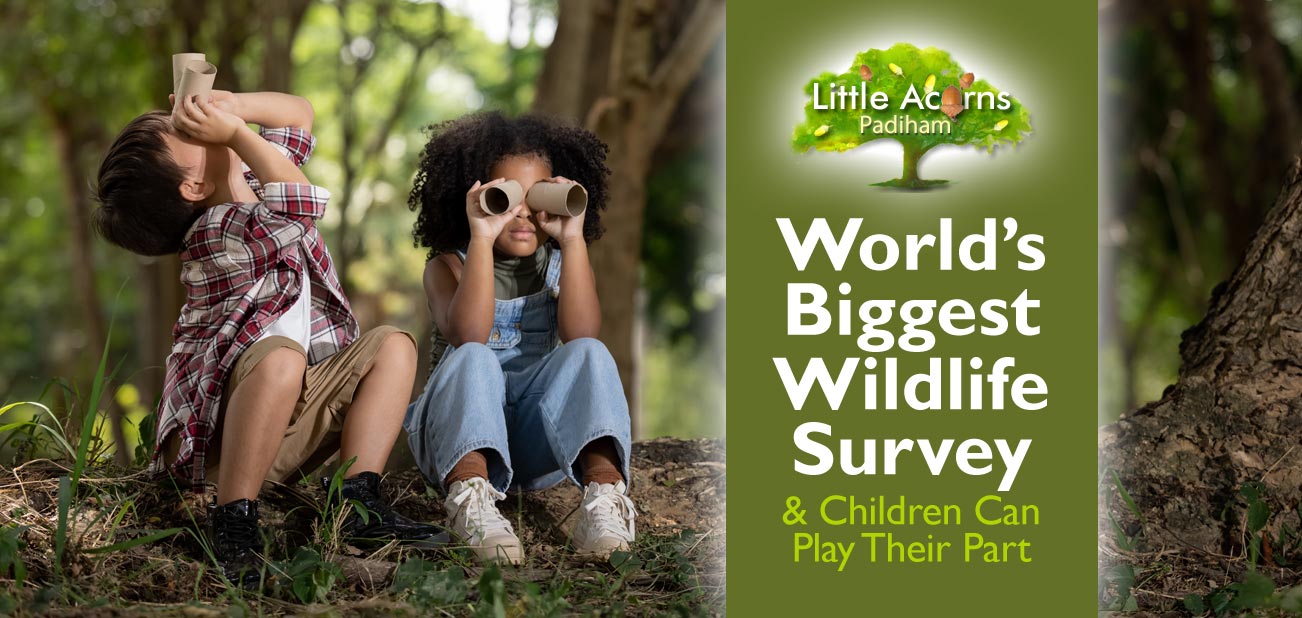
 Children, adults, and whole families are gearing up to take part in the world’s biggest garden wildlife survey in early 2025. Organised by the RSPB (Royal Society for the Protection of Birds), the Big Garden Birdwatch requires just one hour of your time during late January 2025. It’s free, hugely worthwhile, and will benefit nature, conservation, and children themselves. So, why not set a date for your diary and take part? Today’s post explains how to enrol, what to do, and how it will benefit all parties involved.
 The Big Garden Birdwatch is designed to keep tabs on wild bird populations in the UK. It’s a survey that’s been undertaken across the UK every year since 1979 and allows the RSPB and conservationists to monitor whether any bird species are under threat. Sadly, survey findings in recent years have found this to be the case, with overall bird populations having declined by a staggering 38 million in the last 60 years. Song thrushes alone, for example, have declined by 80% and even the UK’s most populous bird species, House Sparrows, have declined by 57% since the survey began.
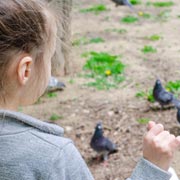
 The Big Garden Birdwatch is also a great way to get children outdoors, close to nature, and to introduce them to the concept of nature conservation. By taking part, children can contribute to bird conservation as well as directly benefit in a number of ways themselves. For example, they can
  Enrolling your child or family into 2025’s Big Garden Birdwatch is easy and free. Simply
  Decide on a natural spot where you’ll undertake your hour’s birdwatch. Your garden, local park or even a balcony will do fine.
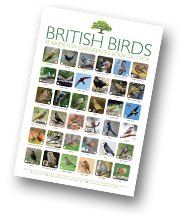 Enjoying Birdwatching?

 Usually, you will need to pay for childcare costs first and then reclaim them through your Universal Credit childcare support account. However, there are some circumstances where you may be able to get some of your childcare costs paid upfront through the scheme. This recent change is designed to help families essentially with cash flow so that a major barrier to working is removed. That, in turn, will also help the economy.
 This is what we call our blog (short for ‘web log’) where we regularly publish guides and useful information for parents of children under five.
  We’re @NurseryPadiham on Twitter, so you can follow us at
  We’re @TotsNursery on Facebook (because we took over the Adventure Tots childcare business), so you can follow us at
  We’re @LittleAcornsNurseryBB12 on Instagram, so you can follow us at
  We’re also @LittleAcornsNurseryBB12 on Pinterest, so you can follow our pins and boards at
  We appreciate that, if you’re reading this, you’ve already found us. However, if you ever need to find us again and aren’t sure where to look, we’re also on Google.
  If you’re a parent of a current child at Little Acorns Nursery in Padiham, why not write us a review? You can
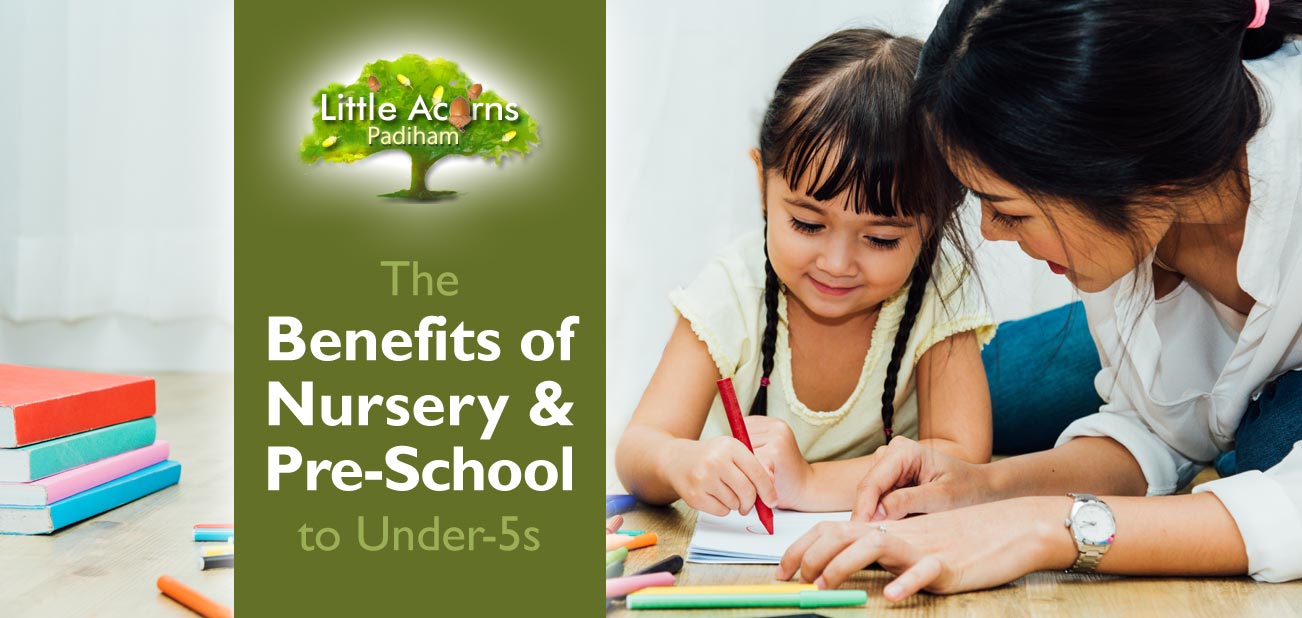
 A good nursery or pre-school is so much more than just a crèche, playgroup, kindergarten or childminding service.
  Nurseries like Little Acorns in Padiham provide a dynamic environment where children mostly learn through different types of play and pre-planned, carefully structured activities. Much of their learning is achieved through the application of the
  A good early years childcare provider like Little Acorns will also nurture every aspect of children’s personal development. Research suggests that starting childcare and a good early years education at a young age can have significant positive effects on children’s development.
 Spending time at nursery and pre-school provides children with countless opportunities to interact with peers and to learn to socialise with others. Through doing so, they’ll develop their social skills generally, including things like learning good manners, needing to sometimes share or take turns, learning about mutual respect, and following rules.
 Good nurseries and pre-schools like Little Acorns welcome and support children of all abilities. As part of this and whenever possible, they will create an inclusive environment for children with special educational needs or disabilities (SEND). They’ll support them in every way they can including, where possible, provision of special equipment, adapting the environment to make it more accessible, and obtaining additional funding for extra resources. They’ll even work with outside professionals, where appropriate, to develop the best ‘joined-up’ plan to support children. The result is a positive and responsive culture where children feel comfortable and valued, irrespective of ability or disability.
 All of the above will really help children to develop the skills and confidence they need to absolutely thrive once they start at primary school. As well as being more able and literate from the moment they start, they’ll more easily be able to follow routines, listen to instructions, and work independently. They’ll absolutely hit the ground running with the existing knowledge, tools and abilities that they learned during their all-important early years. Indeed, those children who receive a high quality early years education have been shown to attain higher grades in their GCSEs and can be the equivalent of a year ahead by the time they reach the age of 15.
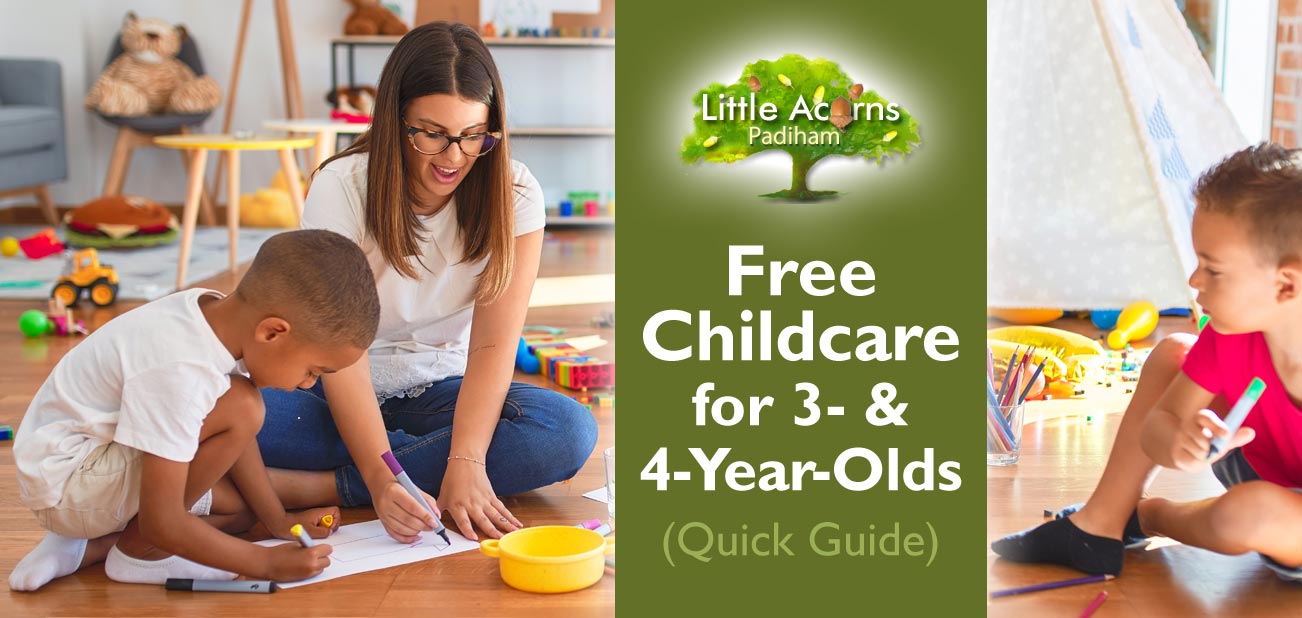
 If you live in England and have a child aged 3 or 4, this article is for you. Did you know that your child is entitled to free childcare each week? In fact, virtually all children aged 3 or 4 that live in England can get an impressive 570 hours of free childcare each year. Some can even get twice that amount of funded childcare hours. Today we’ll go through what’s available – totally free of charge – and the rules around eligibility.
 The ‘15 Hours Free Childcare’ scheme is a Government-funded initiative that provides free early education and childcare for all 3- and 4-year-olds living in England. Under the scheme, eligible children are entitled to 15 hours of free childcare each week, usually spread over 38 weeks, to total 570 hours per year. Optionally, however, some families may choose to have their child attend a childcare setting for less than 15 hours per week but spread the free hour allowance throughout the whole year. Others may prefer to take longer breaks during the holidays and using the hours more intensively during term time. Parents/guardians will need to check what’s possible with their particular childcare provider (we try to be as flexible as possible at
  You must be the child’s parent or legal guardian.
 The ‘30 Hours Free Childcare’ scheme is a very similar Government-funded initiative that provides eligible families in England with up to 30 hours of free childcare per week. Again, this is for children aged 3 and 4. The scheme is designed to help working families with the cost of childcare and to support parents who want to return to work or increase their hours.
 You are usually still be eligible if you are off work on annual leave or sick leave, or parental leave if it is not being taken for the same child you are claiming childcare funding for.