Since November 2025, Ofsted has been rolling out new-style assessments for early years providers, schools, higher education settings, and skills providers. Parents will therefore start to notice the new way of presenting Ofsted ratings. They are multifaceted, with comprehensive detail, and also provide contextual information and metrics that give greater meaning to assessment conclusions.
Key to the new Ofsted assessments is the new, multi-part Report Card. This combines a quick, colour-coded snapshot of the setting’s performance, with sub-sections that delve deeper into how the setting measured up against key areas. All of this replaces the historical approach that, until now, simply used short, some would say controversial, one or two-word “judgements” — Outstanding, Good, Requires Improvement, or Inadequate. Today, we take a look at the new Report Card, explaining how it is presented and what information this new assessment reporting will contain.
The New Ofsted ‘Report Card’
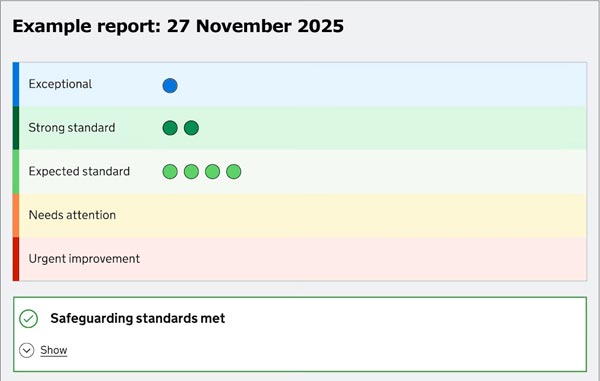
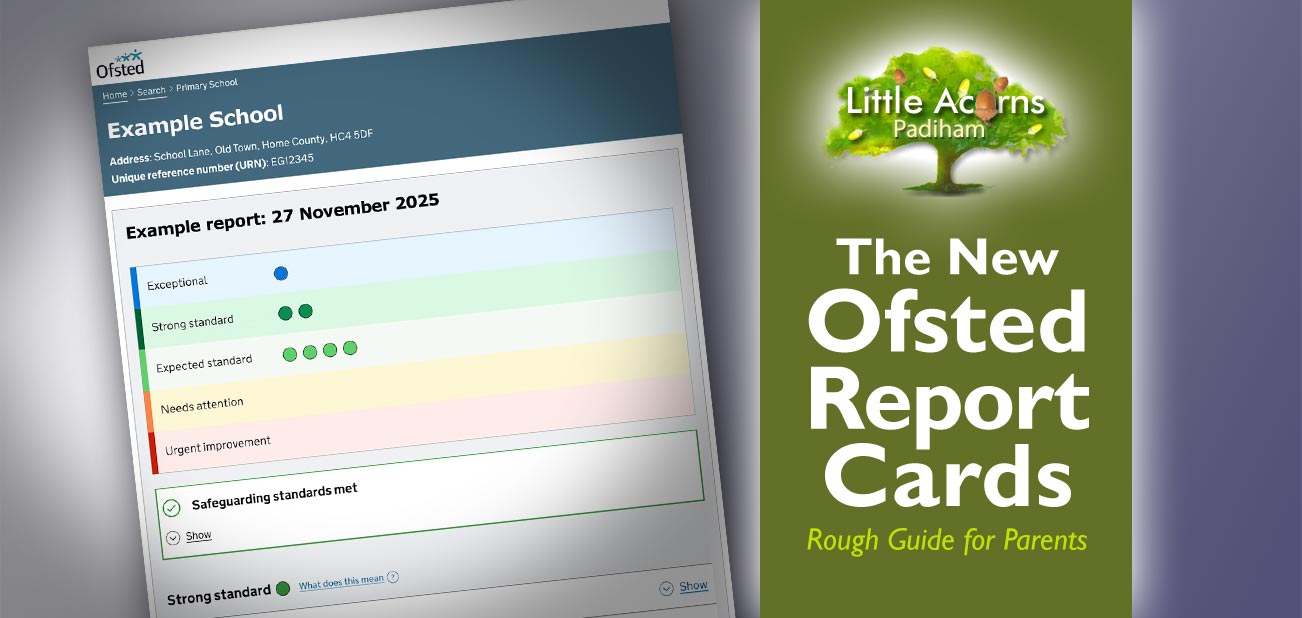
As you can see in our example, the most prominent part of Ofsted’s new Report Card is a colour-coded area that indicates how the setting performed, at a glance. Coloured dots represent key areas and what ‘grade’ they achieved, although they’re not named at this stage. The distribution of coloured dots is a way to see, very quickly, how a setting is performing overall.
- Areas judged to be ‘Exceptional’ are denoted by blue dots;
- Those with a ‘Strong standard’ are awarded dark green dots;
- Those reaching the ‘Expected standard’ are indicated by bright green dots;
- If an area ‘Needs attention’, it’s indicated by an orange dot;
- And finally, areas that need ‘Urgent improvement’ will be shown as a red dot.
If all is well at a setting, parents will see just greens and, if exceptional in any areas, blues. A good facet of this new approach is that, if a setting is doing well in many of its key areas, it will no longer “live or die” if there is a shortcoming in another key area. Yes, they may see an orange or red dot, but they’ll also be able to instantly spot that the setting is doing well in other areas (green and blue dots). So, it’s a more comprehensive and balanced way to represent a setting.
What Key Areas do the Coloured Dots Represent?
The coloured dots represent defined “key areas” assessed by Ofsted inspectors. The key areas vary a little depending on the type of setting being assessed, as listed in the tabulated sections below.
Safeguarding on the Report Card
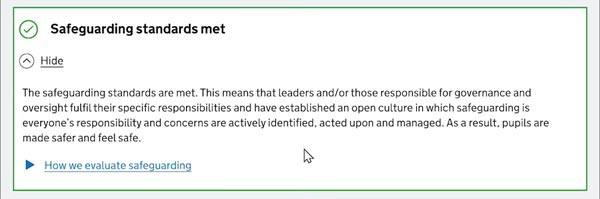
Safeguarding features prominently on the Report Card for all types of settings. It does so in a separate section of its own, below the top colour-coded section. There are just two possibilities for the assessment of the setting’s safeguarding: either Met or Not Met. And, as with many of the subsequent inclusions on the Report Card, the Safeguarding box is expandable. Users can click the ‘Show’ link to view detailed notes explaining what the finding means (see example below) and a further link that explains how safeguarding was evaluated by Ofsted. Both links can then be closed to return to the more compact view.
The Key Areas Section of the Report Card
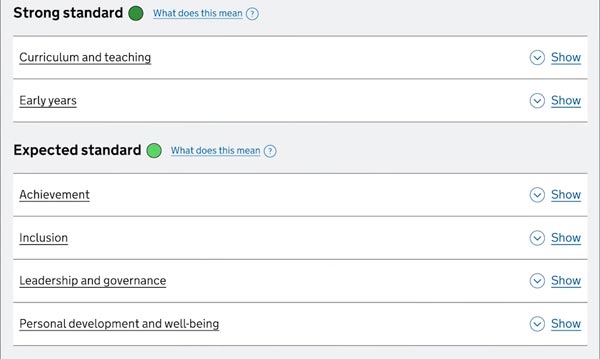
After the Safeguarding section comes the individual ‘key areas’ that we listed above and which were graded higher up in the colour-coded section. Grouped by attainment/colour (best/blue at the top), each now has an expandable box of its own. As with the Safeguarding box, users can click a ‘Show’ link that enables detailed Ofsted notes to be displayed. Such notes go into great detail about Ofsted’s findings about the metric in question. So, if the attainment is high, parents will be able to see how and why Ofsted thinks that to be the case. Likewise, if the attainment is lacking in some way, parents can see why Ofsted thought so and what they suggest the setting needs to do to improve matters.
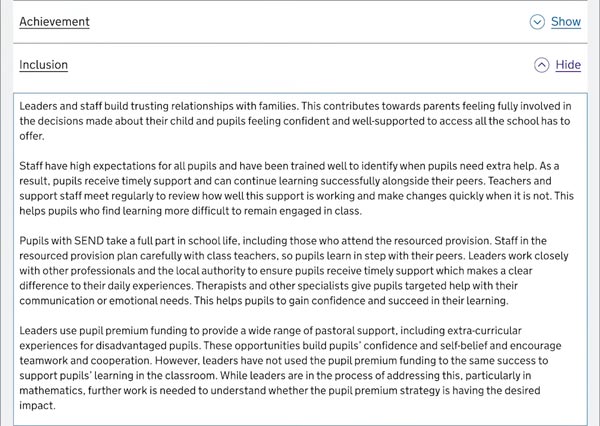
Each of the sections expands as shown for the ‘Inclusion’ example below.
What It’s Like at the Setting & More
Below the Key Areas sections come 3 useful inclusions:
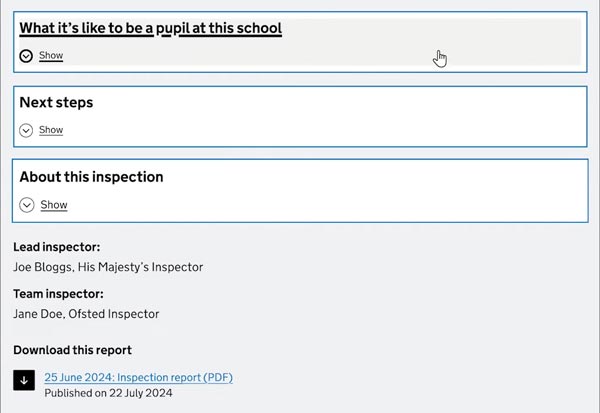
- The ‘What it’s like to be a pupil at this [setting]’ section does ‘exactly what it says on the tin’ and, if expanded to show the detail, explains what life is like at the nursery, school, further education setting or skills provider in question. It’s a new and useful inclusion for parents to consider as part of their search for an appropriate provider for their child.
- The ‘Next Steps’ section provides recommendations from Ofsted about what the provider can do to improve things (as appropriate).
- The ‘About this inspection’ section comes next and, if expanded, explains more about the inspection process on the day the Ofsted Inspector visited.
- The report card then goes on to name the Inspector(s), as well as providing a link to download the Inspection Report as an Acrobat PDF file.
The Facts & Figures Section
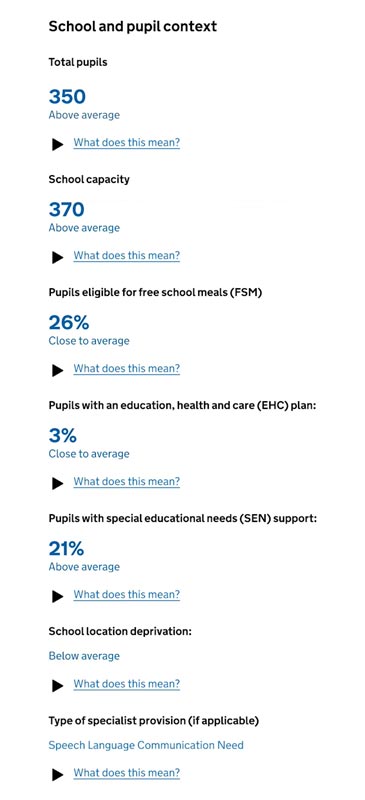
The final section in the Report Card contains contextual information that provides a kind of backdrop to the setting’s situation. Examples include the number of pupils attending, the capacity of the setting, the percentage of pupils with SEND and/or an EHC plan, whether the setting is in a deprived area, and so on. Click here to view an example. Such facts and figures provide some important context, including the highlighting of some challenges they may face, and may at least partly explain performance. As such, they are a useful set of new metrics for parents to factor in when finding a provider for their child.
Little Acorns Nursery, Padiham
Rated as a ‘Good Provider’ by Ofsted
 Little Acorns Nursery, Padiham, has not yet had a new-style Ofsted assessment. However, the setting has a ‘Good Provider’ status following the most recent Ofsted inspection back in May (2025). Indeed, Ofsted rated the nursery as ‘Good’ in every category. What’s more, at the time of writing, the nursery has a review rating of 5 out of 5 on Google and 10 out of 10 on DayNurseries.co.uk — it simply doesn’t get better than that! Parents can therefore rest assured that, if they send their child to Little Acorns Nursery in Padiham, they’ll be in safe and caring hands at a childcare setting that does everything it can to nurture their learning and development. That’s all in a safe, homely, and stimulating environment.
To register your interest for a nursery place, organise a tour of the setting, or ask any questions, please get in touch using one of the options below. We can’t wait to meet you and your child!
Families outside Padiham, but living in nearby locations, may also find Little Acorns Nursery convenient for their childcare needs, for example, those in Burnley, Hapton, Rose Grove, Altham, Huncoat, Read, Simonstone, Sabden, Higham, and Wood End.
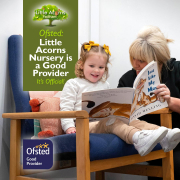
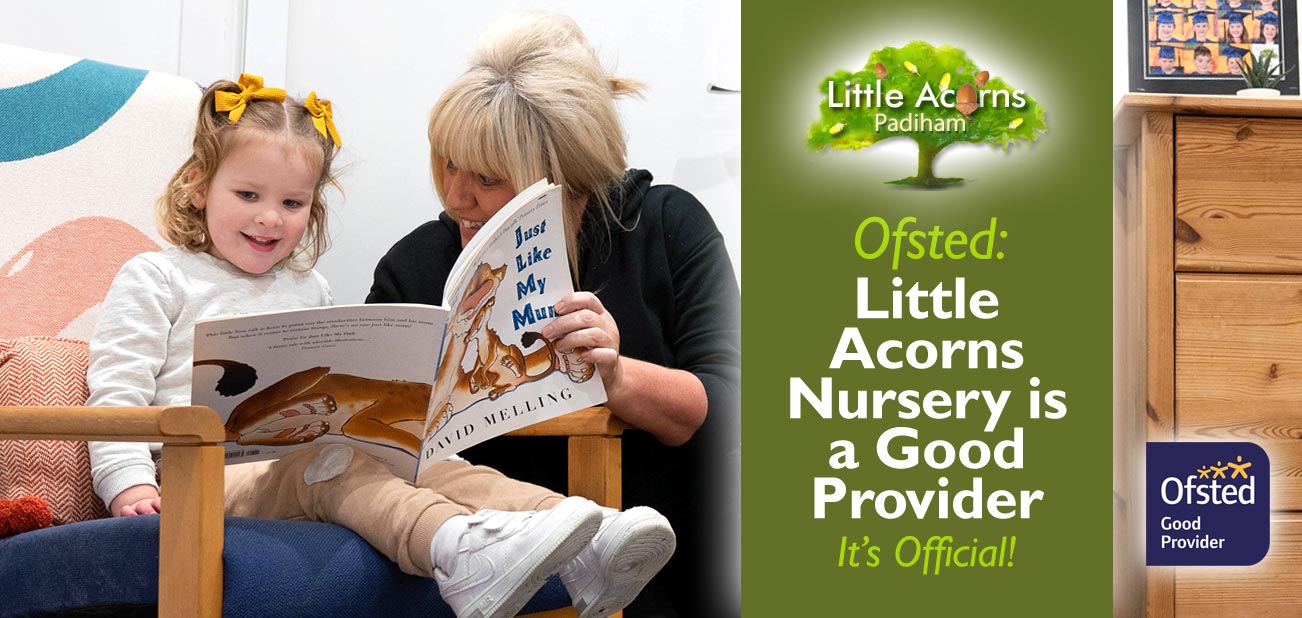
 We’re delighted to announce that Ofsted has published a stunning report for Little Acorns Nursery, Padiham. It’s now official that this excellent Padiham childcare setting is a ‘Good Provider’ — in every category! What’s more, the Ofsted inspector published some wonderfully positive comments about the nursery, staff, and quality of care as part of the report. Their findings are a testament to the high quality of the setting, the professionalism of its early years practitioners and leadership, and the positive impact the nursery has on babies and children in its care. Today, we take a deep dive into the details.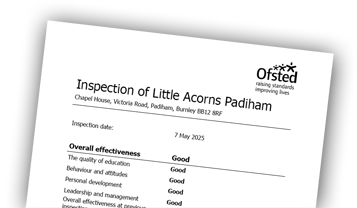

 Attention working families: applications are now open for eligible children, aged from only 9 months, to receive 1140 hours of free childcare per year from September 2025. What’s noteworthy is that this will be the first time such young infants and toddlers can access so many free hours. It effectively doubles the number of free childcare hours previously available to those under 2 via the scheme. The new, extended funding is for eligible working families, who now have until the 31st of August to apply if they would like their child(ren) to start in the September 2025 term.
 This newly extended scheme will be profoundly beneficial to parents, children, the business world, and the economy. Let’s take a look:
 The funded childcare is for children of working parents with earnings within the specific range outlined below. Under this scheme, children receiving the free hours from the September 2025 term must be aged no less than 9 months old on 1st September 2025 and free funding for those who remain eligible is available right up until school age.
 As our families regularly confirm, Little Acorns in Padiham is a highly-regarded childcare nursery that attracts
 Today, we remind Padiham families that Little Acorns Nursery supports the new — free — childcare scheme for eligible children including babies as young as just 9 months of age. Although it’s available only to eligible working families, the bar to entry is fairly low. The childcare funding is therefore attainable for many families. This free childcare is not just limited to babies either and, what’s more, it’s due to become even more generous from September 2025. In our guide below we’ll outline who is eligible, how much childcare funding they can access, how many childcare hours that equates to, and what the eligibility criteria are. If you’re the parent of a baby, toddler, or child up to three years old, this is for you.
 For those working families who are eligible, the scheme provides 570 hours per year of free childcare to children aged from 9 months to 3 years. This is normally taken as 15 hours per week for 38 weeks, usually aligning with the standard educational term-time weeks for school timetables. That said, it may be possible to stretch the hours over more weeks of the year if your childcare provider is able to accommodate such flexibility.
 We’ll try to simplify the eligibility criteria for you. Whether it’s for a baby aged 9 months, a toddler of 1 or 2, or a child aged 3 or 4, there are essentially four main criteria for this specific type of childcare funding:
 Well, it’s good news. It’s already the case that all 3 and 4-year-olds living in England are eligible to receive 570 hours (15 per week) of free childcare anyway. That’s available under what’s known as ‘Universal Entitlement’, a Government childcare funding scheme that’s been around for some time. What’s more, those working families that are eligible for the ‘new’ free childcare for children aged 9 months to 3 years are also likely to be eligible for a top-up of their child’s Universal Entitlement once they reach the ages of 3 and 4. In those cases, they’ll be entitled to 30 hours per week over 38 weeks (or however the 1140 free hours are spread out). That’s because the eligibility criteria are the same (see section above).

 Pyjamarama is a one-day fundraising event that’s organised through the children’s reading charity BookTrust. It takes place each year across a variety of UK settings including homes, schools, preschools, nurseries and more. As well as being great fun for those organising and taking part, the initiative is beneficial to millions of disadvantaged children. The ultimate aim is to raise money to fund the purchase of books and resources, so that every child in the UK gets the chance for bedtime stories and each family has proper reading opportunities. The initiative is hugely popular, great fun, and transforms lives. Today, we take a look at what to expect, how to get involved, and the many benefits of Pyjamarama.
 Pyjamarama is always a fun day for both adults and children. The added aspect of pyjamas makes it special, quirky and relaxed. And, at the end of the day, it’s incredibly worthwhile. Not only does it raise money to give disadvantaged children and their families opportunities for reading and bedtime stories, but it also encourages those children taking part in Pyjamarama to read more, for pleasure as much as anything. Additionally, it gives children a different perspective and encourages altruism and empathy for others less fortunate than themselves.
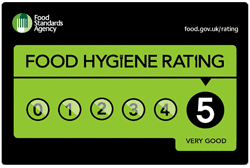 Our Padiham nursery had its annual inspection by the local Environmental Health Officer recently. The purpose was to ensure, as required in all settings serving food, that Little Acorns Nursery has high standards of hygiene and follows the food preparation guidelines specified by the UK’s Food Standards Agency. Once again, Little Acorns Nursery passed with flying colours, achieving a full 5-star rating. That’s the best rating possible and reflects the highest levels of quality for food preparation, the food itself, cleanliness, and competence of staff. So, our thanks and utmost respect go to Kim, our in-house chef/cook, whose high standards, skill and expertise do the children and the nursery proud.
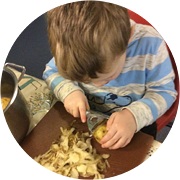 Because the recipe heavily involved potatoes, this also tied in nicely with the book Supertato, which our preschoolers have been looking at in tandem with discussions about food and the importance of a healthy diet. The photo shows one of the children peeling potatoes. Others peeled vegetables and even made their own dumplings. The fun activity helped to nurture children’s learning and the development of new skills and knowledge. The final result was both tasty and a huge hit with the little ones!
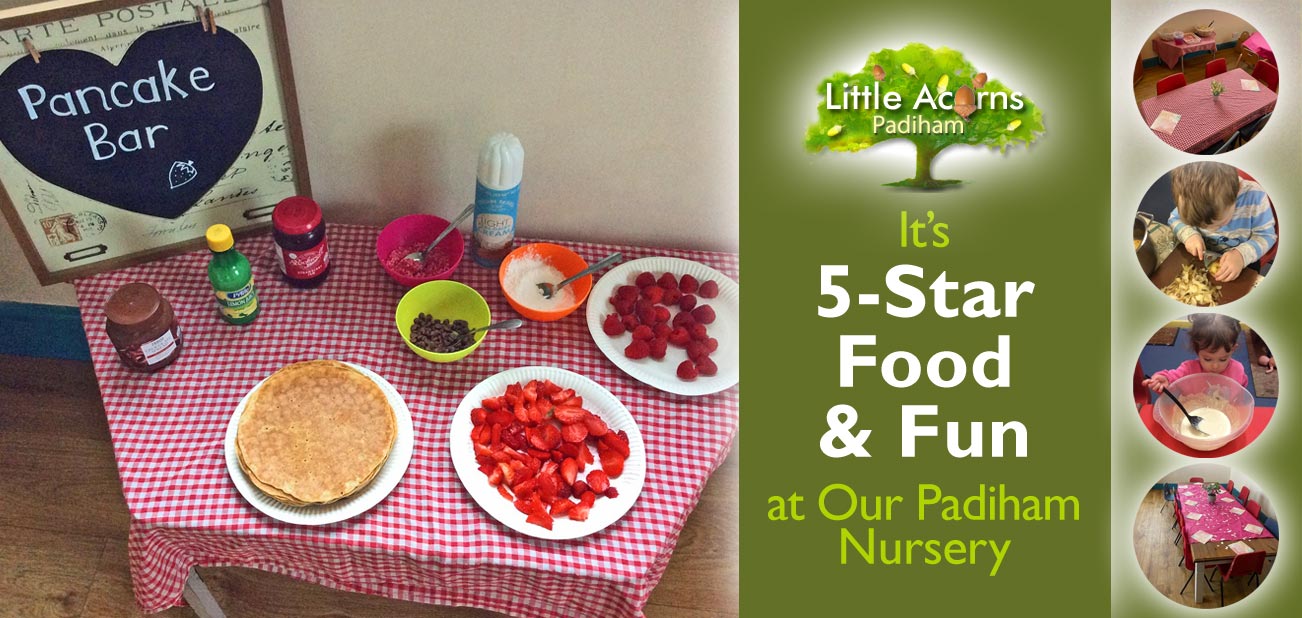
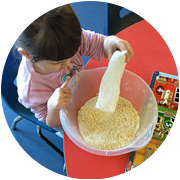 Shrove Tuesday, a.k.a. Pancake Day, arrived on the 13th of February and it gave us a great opportunity to organise pancake-themed activities for the nursery/preschool children … for the entire week! After all, who doesn’t love pancakes? So, as you’ve no doubt guessed by now, our Recipe of the Month for February was home-made pancakes and it’s a recipe the children really enjoyed getting involved in. They loved mixing ingredients in a bowl to make their own pancake mix. We even set up a ‘Pancake Bar’ (see the main photo at the top), which included lots of yummy toppings that children could use to decorate their pancakes. The toppings included strawberries, bananas, chocolate spread, jam, lemon, sprinkles, honey and cream.
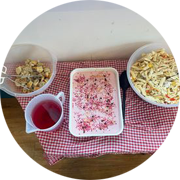 Valentine’s Day, which arrived on the 14th of February, also involved lots of food. After all, as the saying goes, it is often thought of as the language of love! At the nursery, we organised a lovely Grab ‘n’ Go Breakfast for our parents. This was followed by a special 3-course Valentine’s Day meal for our children in our lovely new dining room, which was set up like a little restaurant (see the photos). Children had sausage rolls to start, cheesy chicken and red pepper pasta for the main course and strawberry mousse – with sprinkles – for pudding. Accompanying this was some delicious blackcurrant juice. It all went down a treat with our nursery children, as did several other activities that were themed towards Valentine’s Day.
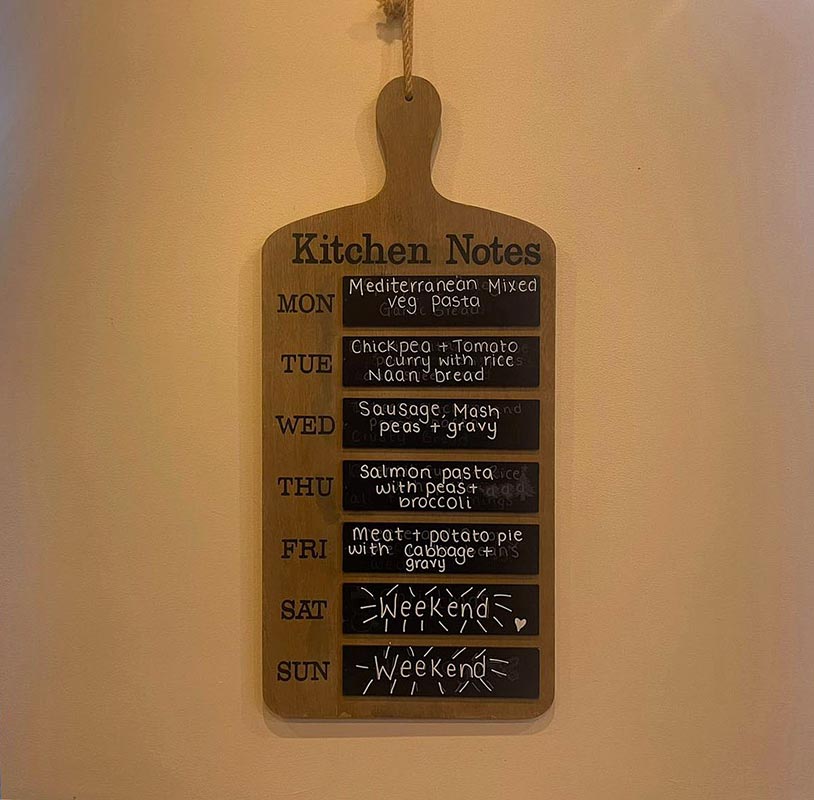
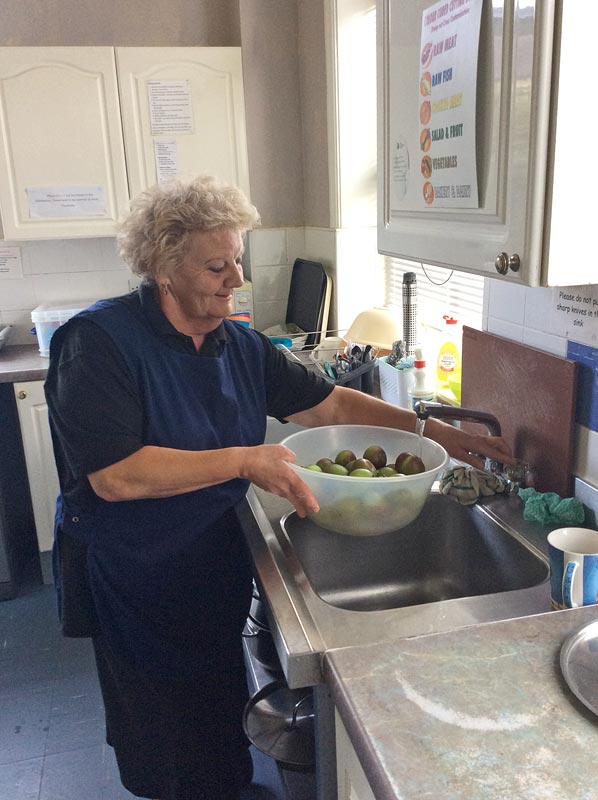
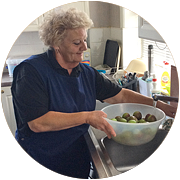 Kim, our talented in-house chef, prepares tasty home-made meals and healthy snacks for children at the nursery. Meals are prepared freshly, on site, using high-quality ingredients, which are locally sourced whenever possible. They are delicious as well as being nutritionally balanced to include a healthy mix of fish, meat, pulses and vegetables.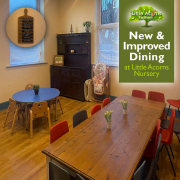
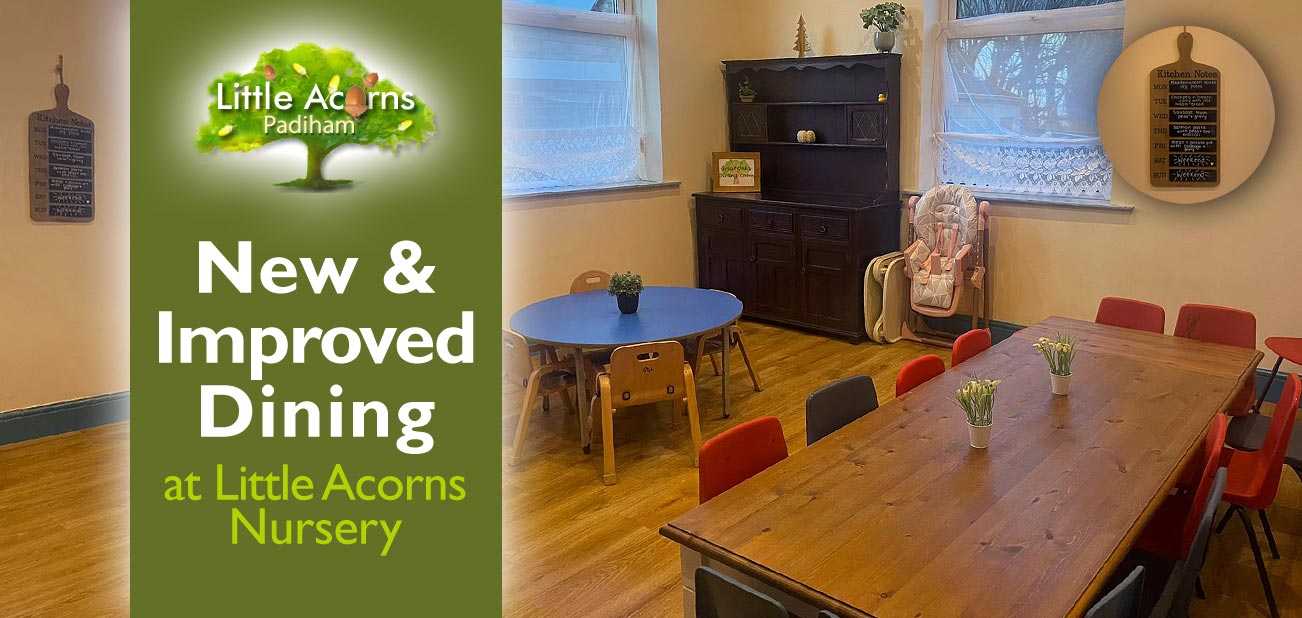
 To make way for the new children’s dining room, an existing room at the setting was repurposed and totally revamped. Starting in Summer 2023, the contents of the existing room were sorted and relocated where needed, leaving a wonderful new space to use as the new ‘Great Oaks’ dining room. Walls, ceilings and skirting boards were prepared and freshened up with new paint. Attractive William Morris-style wallpaper was also hung on a ‘feature’ wall. Large canvas wall images were displayed to form interesting focal points and storage was added in the form of a large cabinet and a small cupboard. Large and small dining room tables and chairs were added for the different age groups along with high chairs, which will be close at hand whenever needed. All this sits on a durable floor with an attractive wood finish. All in all, the outcome is a pleasant home-from-home for children.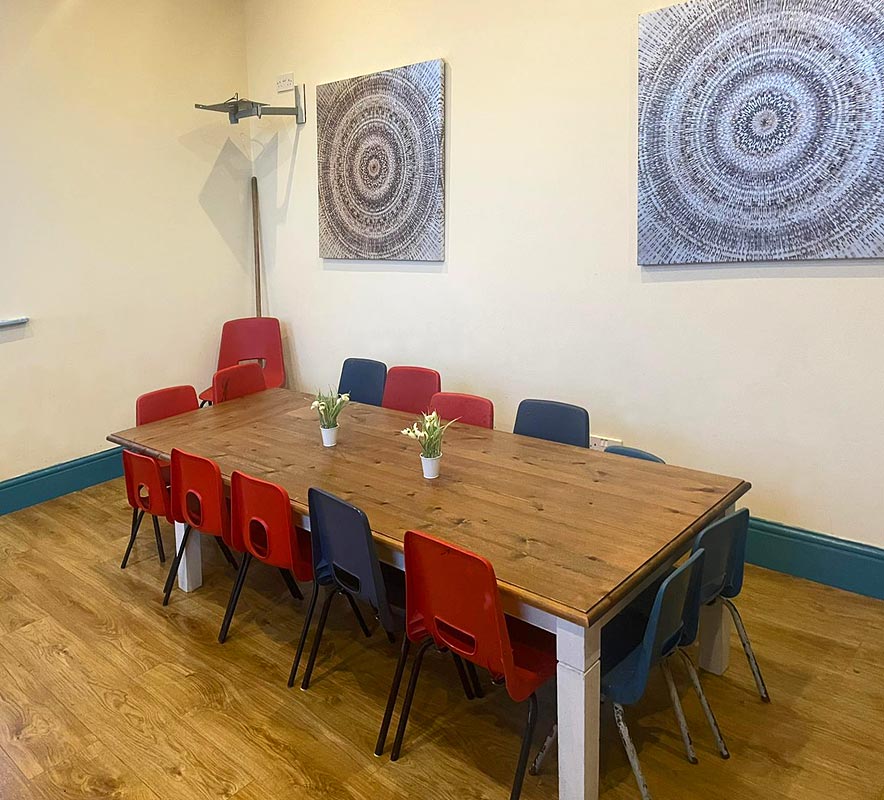
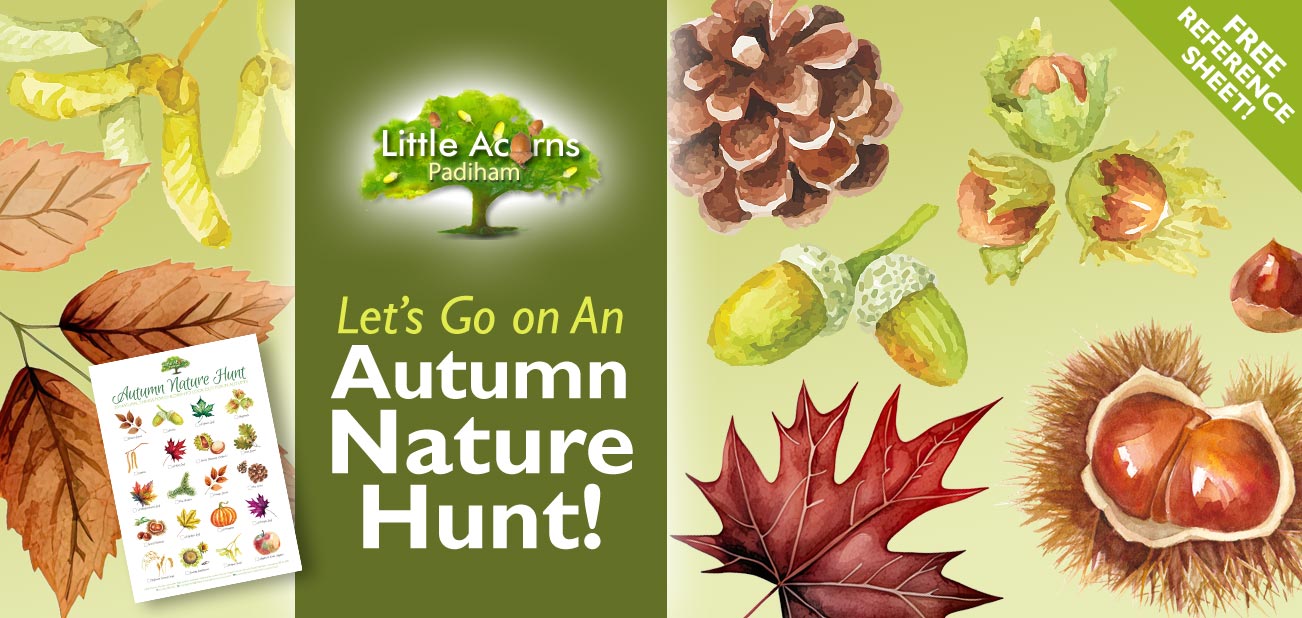
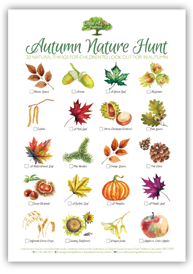 As leaves start to blanket the ground and the earthy scents of autumn begin to infuse the air, it’s the perfect time to engage children in a captivating adventure that celebrates the season. In today’s post, we’ll introduce you to an Autumn Nature Hunt, an exciting outdoor activity for children that’s not only entertaining but also educational.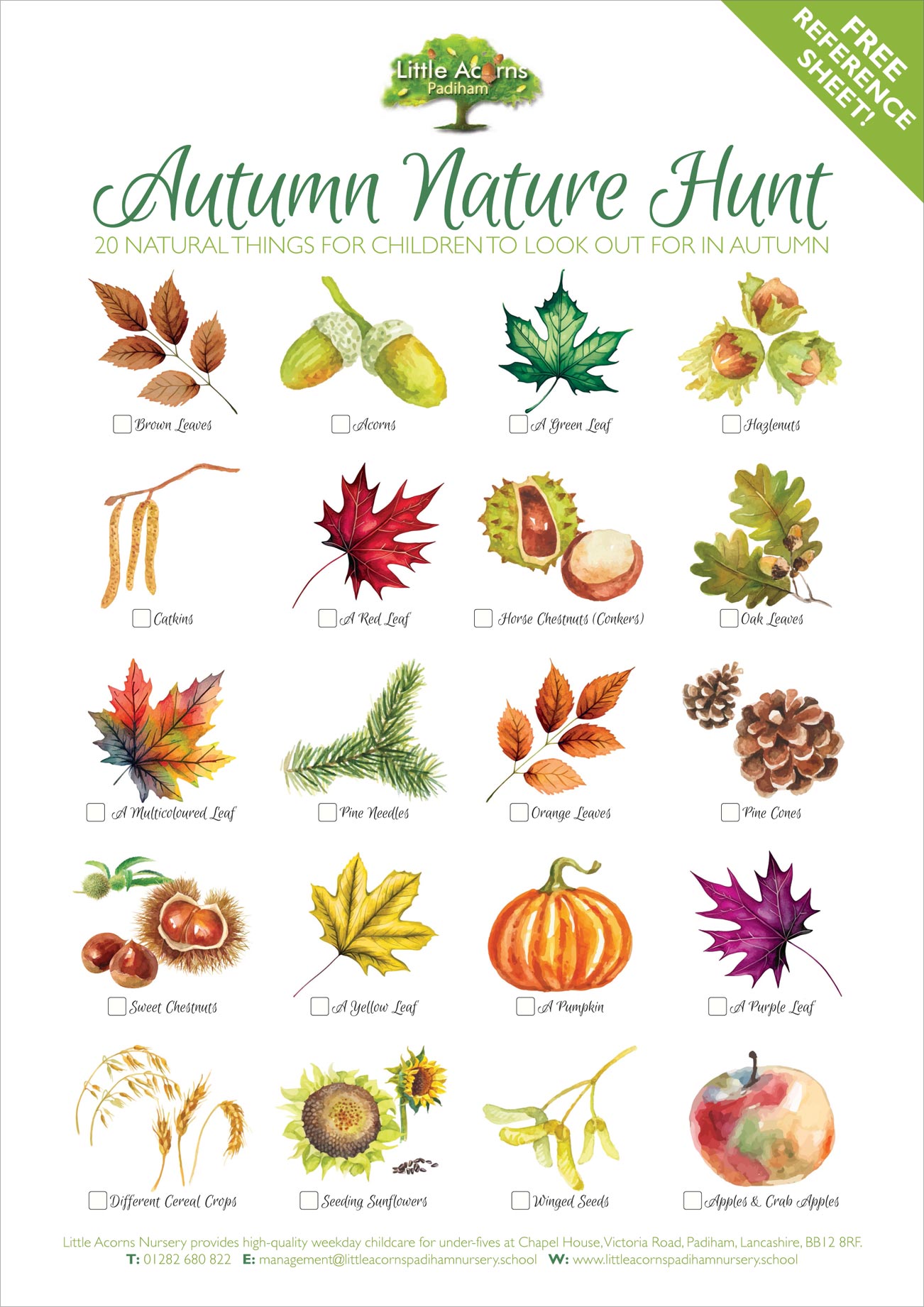
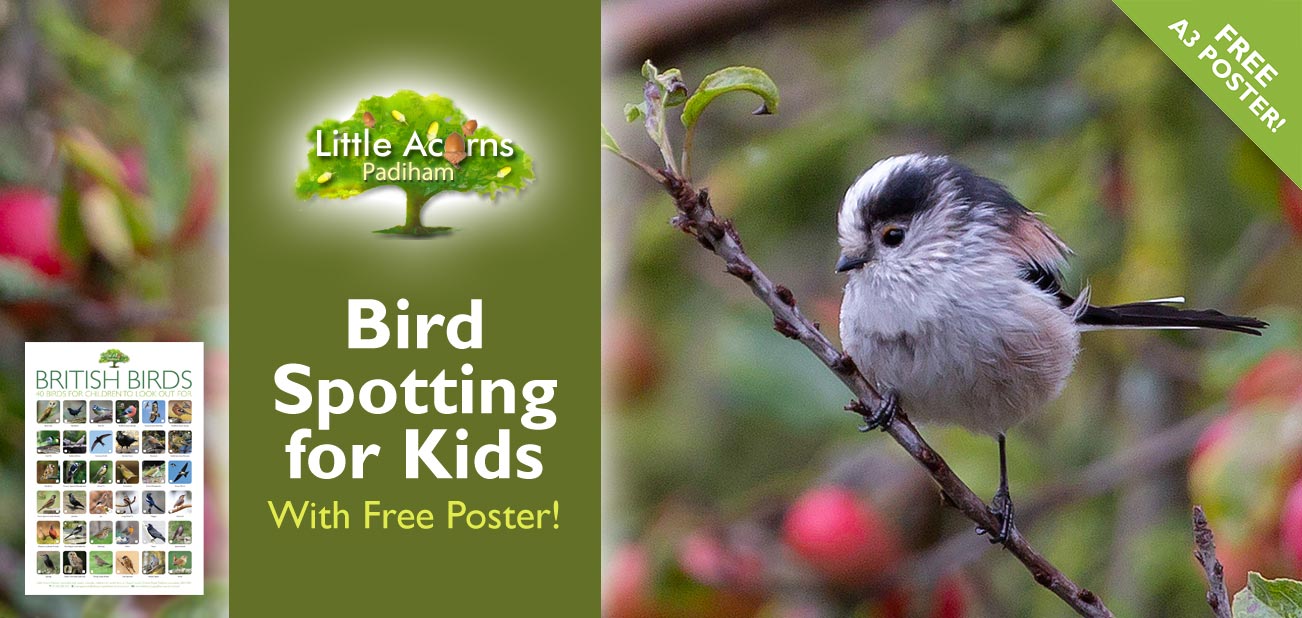
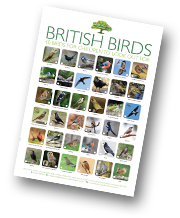 Today’s bird spotting activity for kids continues our series of nature-themed posts that each come with a free reference poster for families to download. Featuring 40 British birds, the activity and the poster represent a great opportunity to get children of all ages outdoors, closer to nature. As many of us know,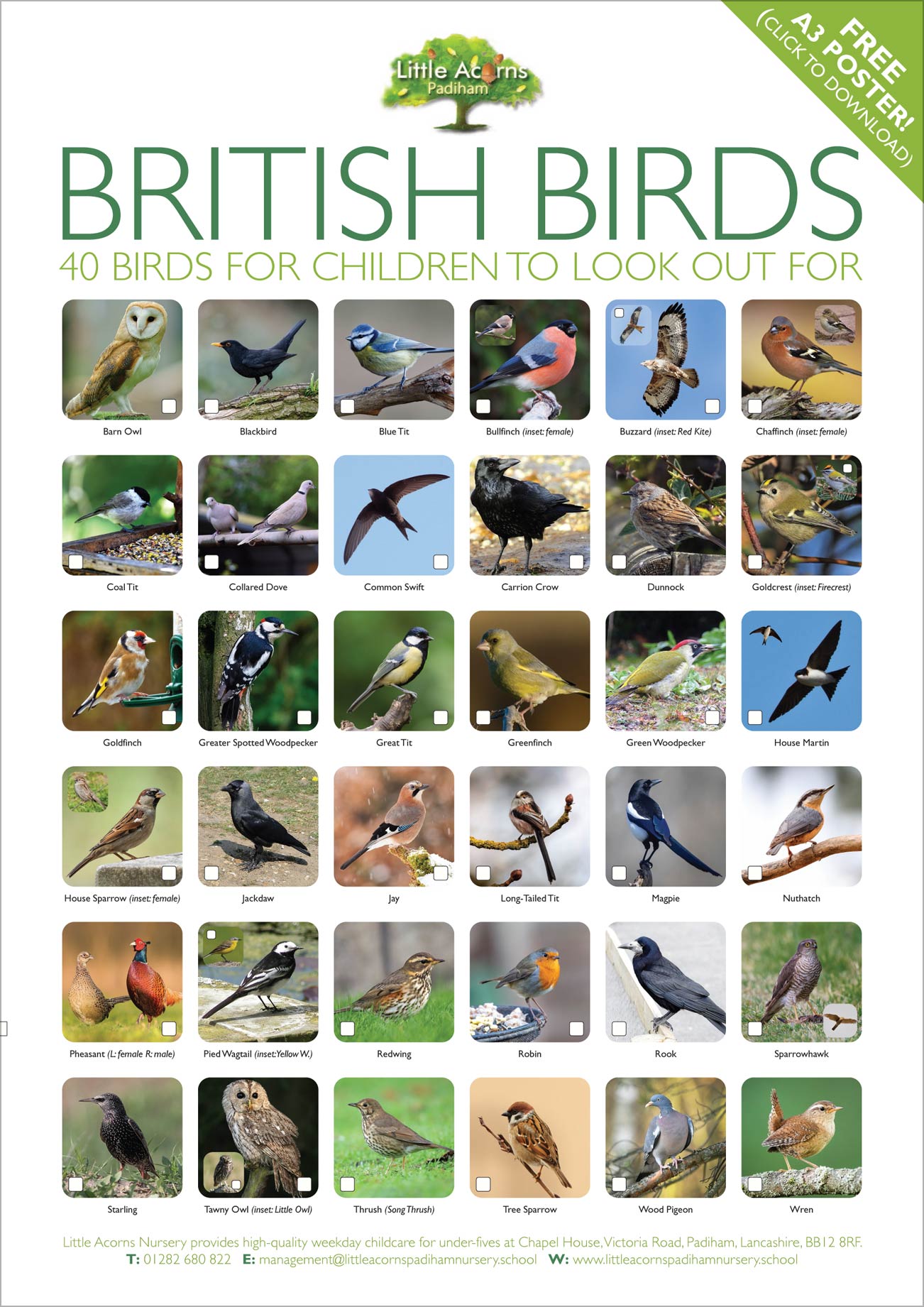
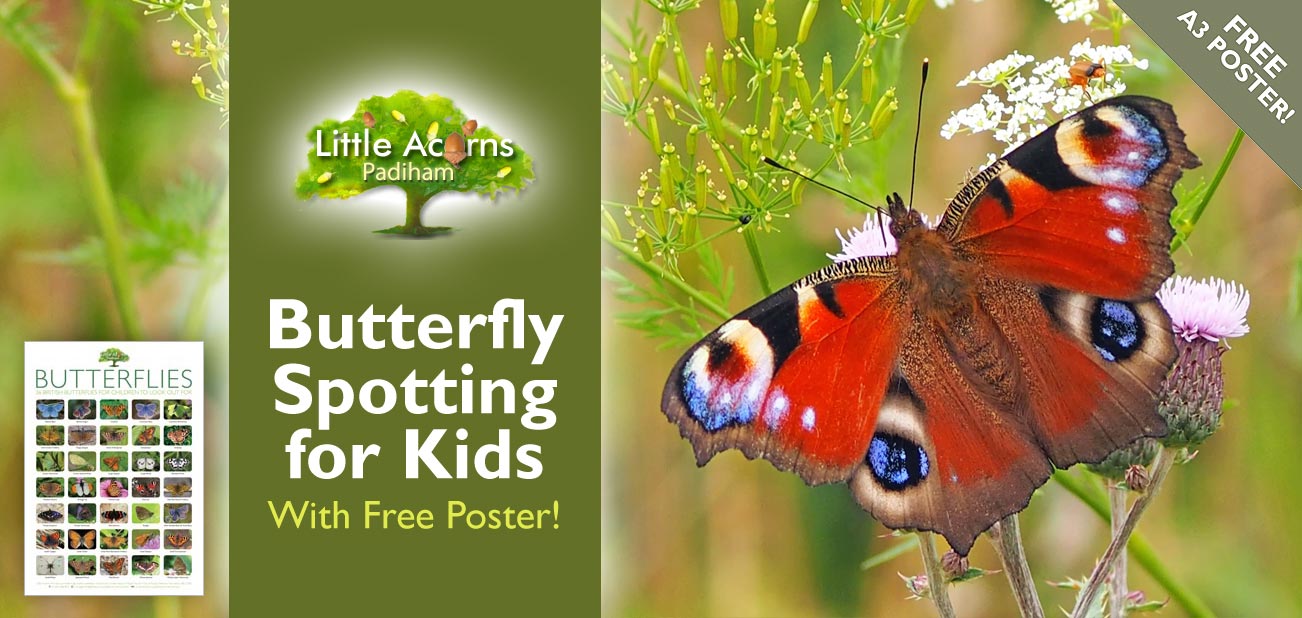
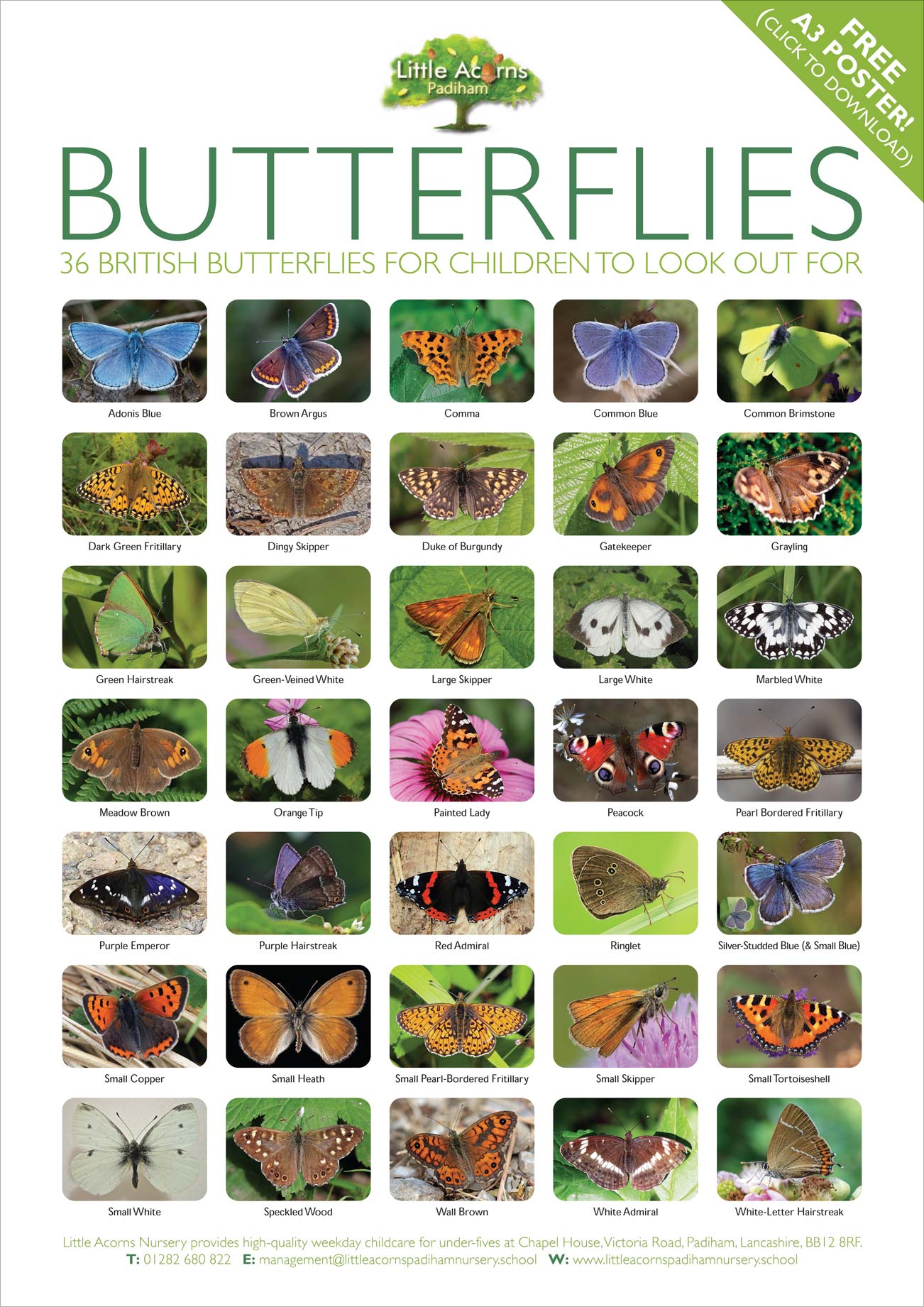
 At the time of writing, it’s peak butterfly-spotting time — more adult butterflies can be seen in late July and early August than at any other time in the year. That makes it the perfect time for children to get out in nature to spot these charming creatures. Doing so is fun, educational and also beneficial in so many ways – we’ll explain more about that later.